Spain ER, 112 or Online Doctor? A Practical Decision Guide for Expats

Medically Reviewed by Dr. Pedro Yelamo Vera, MD
Licensed Physician No. 484814280 · Official Medical College of Bizkaia (Spain)Last reviewed: 20 October 2026
Not every health scare needs a hospital waiting room. Here is a clear, practical way for expats in Spain to decide between calling 112, going to urgencias, or booking an online doctor.
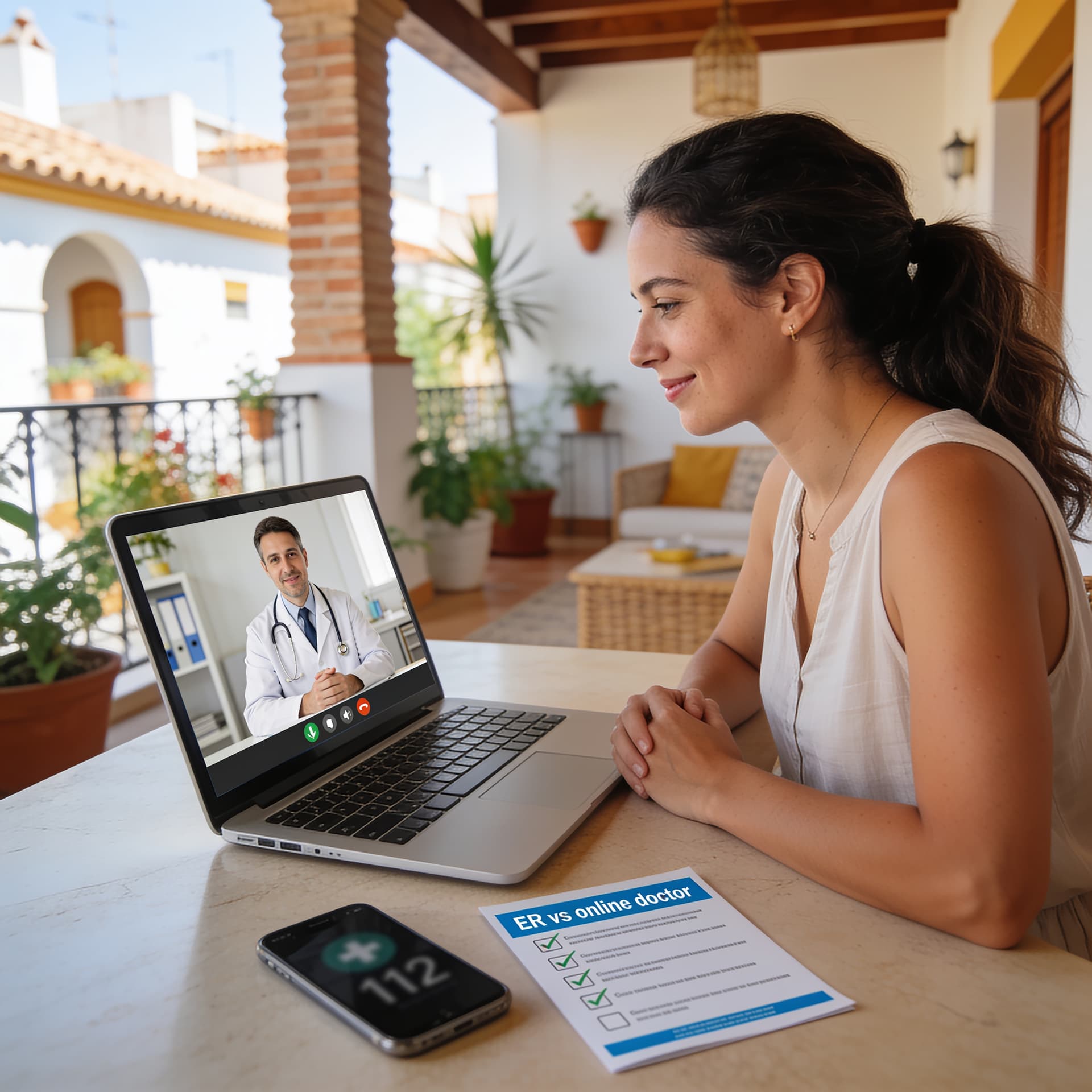
You don't have to figure this out alone
Dr. Pedro Yelamo Vera is an independent, bilingual GP licensed in Spain. Book a 15-minute video consultation in English or Spanish for €50, with a private electronic prescription issued under Spanish law when clinically appropriate.
How an online consultation works
Dr. Pedro Yelamo Vera explains, in under a minute, what happens during a private video consultation — from booking to your private Spanish e-prescription or medical report.
The short answer: call 112 for anything life-threatening. Go to hospital urgencias for urgent problems that need hands-on care today, like a deep cut or a possible broken bone. For most other worries, an online doctor is a good first step, and will tell you clearly if you need to go in person.
You are new in Spain, and something feels wrong. Do you call 112? Go to urgencias? Or can an online doctor sort it out in a 15-minute video call from your sofa? When you do not yet know how the Spanish system works, that decision is stressful. This guide gives you a clear, repeatable way to make it.
- Call 112 only for true emergencies: chest pain, stroke signs, severe bleeding, loss of consciousness, a severe allergic reaction or major injury.
- Go to urgencias for urgent but stable problems, like a broken bone, a deep cut or a high fever, that need in-person care today.
- For everyday problems like a UTI, traveller's diarrhoea, sinusitis, a rash or a refill, an online doctor is often a good first step.
- You do not need a Spanish health card for private urgencias or an online consultation.
- If you are unsure and no red flags apply, an online doctor can assess you and tell you clearly if you need more care.
Why this matters
Spain's public healthcare system is excellent, but it is triaged. Hospital emergency departments (urgencias) are for problems that threaten life, a limb or an organ. They are not for a bad cold, a likely urinary infection (UTI) or a rash after a beach day.
Going to urgencias for a non-emergency can mean hours in a waiting room, often in Spanish. You also wait behind people who are critically ill. Calling 112 for something that is not an emergency ties up help meant for someone having a heart attack. Knowing which lane you are in protects your time and the system.
Who this is for
This guide is for expats, remote workers and long-term travellers in Spain. It is most useful if you do not yet know how urgencias, health centres (centros de salud) and 112 fit together. It also helps if you have no Spanish GP yet, or if medical Spanish is hard for you under pressure.
The three lanes, explained
Lane 1: Call 112 — this is a true emergency
112 is the free emergency number used across the EU. You can call it from any phone in Spain, even with no credit or with a foreign SIM. Call it, or ask someone to call it, for:
- Chest pain, pressure or tightness, especially with sweating or shortness of breath.
- Sudden weakness, numbness, slurred speech or a drooping face (possible stroke).
- Severe difficulty breathing, or choking.
- Heavy bleeding that will not stop.
- Loss of consciousness, or a seizure.
- Signs of a severe allergic reaction (anaphylaxis), such as a swelling throat or widespread hives with breathing trouble, after a sting, food or medicine.
- Major injury from a fall or an accident.
- A suspected overdose or poisoning.
In most regions, operators speak English or can connect an interpreter. Tell them where you are as exactly as you can. If you are in doubt during a sudden, serious situation, call: it costs nothing, and the team will guide you. Our guide to emergency numbers in Spain also explains 061 and the other numbers worth saving.
Lane 2: Go to urgencias — urgent, but not a 112 call
Hospital emergency departments (urgencias) and out-of-hours primary care emergency centres are the next step down. They deal with problems that need in-person care today but are not immediately life-threatening. Examples are a broken bone, a deep cut that may need stitches, a high fever in a young child, or sudden severe tummy pain.
You will be triaged on arrival, so the most serious cases are seen first. If your problem is not critical, the wait can be long, especially in a public hospital. If you have private health insurance, you can also use a private hospital's emergency department. Check your policy first.
Lane 3: Book an online doctor — often the right lane
Many problems that send worried expats towards a hospital do not need a hospital at all. Examples include a likely UTI, traveller's diarrhoea, sinusitis, minor skin problems, a seasonal allergy flare, jet lag or a medicine refill. Sometimes you simply need a second opinion in your own language before you decide what to do.
A video consultation with an English-speaking doctor licensed in Spain can:
- assess your symptoms and give clear advice;
- issue a private electronic prescription under Spanish law, only if it is clinically indicated after the assessment (it is never guaranteed);
- tell you clearly to go to urgencias or call 112 if there are warning signs.
You join from home, and you do not need a Spanish health card. An urgent care video consultation lasts 15 minutes and costs €50. It is for urgent, non-emergency care. Consultations run every day, 07:30–20:30 (Spain time).
Not sure which lane you're in? Get a clear answer
A bilingual online GP consultation can tell you what your symptoms need. That may be urgencias, a specialist referral, or care from home, wherever you are in Spain.
Public healthcare, health insurance and who pays
Who pays for care in Spain depends on your cover, not on which door you walk through:
- Registered residents with a Spanish health card (tarjeta sanitaria) use public healthcare. Visits are free at the point of care, though many people pay part of the cost of prescribed medicines.
- EU, EEA and Swiss visitors with a European Health Insurance Card (EHIC), and UK visitors with a GHIC, get medically necessary public care on the same terms as people insured in Spain. Our EHIC guide explains the details.
- Visitors without public cover are still treated in an emergency, but may be billed later. Travel or private health insurance may pay, so keep every report and invoice.
- Private health insurance usually lets you use a private hospital's emergency department and its network of doctors. Check your policy first.
An online consultation is private care with a fixed fee. You get an itemised invoice to send to your insurer.
A simple decision checklist
- Do you have any red-flag symptom from the 112 list above? If yes, call 112 now. Do not wait for a video consultation.
- Is it urgent but stable (a deep cut, a possible fracture, a very high fever)? Go to urgencias today for in-person care.
- Is it uncomfortable but not dangerous (a likely UTI, a stomach bug, a rash, sinus pain, jet lag, a routine refill)? Book an online doctor first. You will either get a plan or be told clearly to go elsewhere.
- Still unsure, and none of the red flags apply? Book the online consultation. A licensed doctor assessing you live is far better than guessing. If you need more care, the doctor will tell you exactly where to go.
- Getting worse while you wait? Do not wait for your slot. Go to urgencias, or call 112 if a red flag appears.
What to avoid
- Treating urgencias as a walk-in GP. It is built for sudden, serious cases. Non-urgent problems wait a long time.
- Not calling 112 in a real emergency because you are unsure of your Spanish. Ask for English; do not delay the call.
- Assuming you need a Spanish health card (tarjeta sanitaria) before you can get care. Private online consultations and private urgencias generally do not need one. Our guide on seeing a doctor in Spain as a tourist or new expat explains your options.
- Waiting days with a UTI, sinus infection or skin problem, hoping it goes away. An early online consultation can help you avoid an ER trip later.
Comparison at a glance
| Situation | Best lane | Typical wait | Needs Spanish health card? |
|---|---|---|---|
| Chest pain, stroke signs, severe bleeding, unconsciousness | Call 112 | Immediate dispatch | No |
| Broken bone, deep cut, high fever in a child | Urgencias | Minutes to a few hours | No, for private |
| Likely UTI, sinusitis, traveller's diarrhoea, rash, jet lag, refill | Online doctor | A booked slot, any day 07:30–20:30 | No |
| Just unsure what to do (no red flags) | Online doctor to help you decide | A booked slot, any day 07:30–20:30 | No |
FAQ
Is 112 free in Spain, even for tourists or expats without a Spanish SIM?
Yes. 112 is free from any mobile or landline in Spain. This includes foreign SIMs and phones with no active plan or credit.
Can I ask for an English-speaking operator when I call 112?
Yes. Say "English, please" or "Inglés, por favor". Operators will connect you with language support where available.
Do I need a Spanish health card (tarjeta sanitaria) to be seen at urgencias?
No. Public and private emergency departments treat real emergencies whatever your registration status. Billing and follow-up depend on your insurance and residency status.
Can an online doctor prescribe medication for something like a UTI or sinus infection?
Only when it is appropriate. Any prescription depends on an individual medical assessment and is issued only if clinically indicated. An online doctor will never guarantee a prescription before assessing your symptoms.
What if I start with an online consultation and it turns out to be more serious?
Recognising warning signs is part of a licensed online doctor's job. If you need in-person or emergency care, you will be told clearly and promptly to go to urgencias or call 112.
Does my health insurance cover an online consultation?
It depends on your policy. Each consultation comes with an itemised invoice that you can send to your insurer.
One last thing
Most health scares abroad are not emergencies; they are uncertainty. Learn these three lanes, and start with an online opinion when you are unsure and no red flags apply. You will spend less time in waiting rooms and get a clear answer.
This content is educational and not a substitute for medical advice. For emergencies in Spain, call 112.
Medical Citations & Sources
This content is written and reviewed by a licensed physician with reference to the following official health authorities.