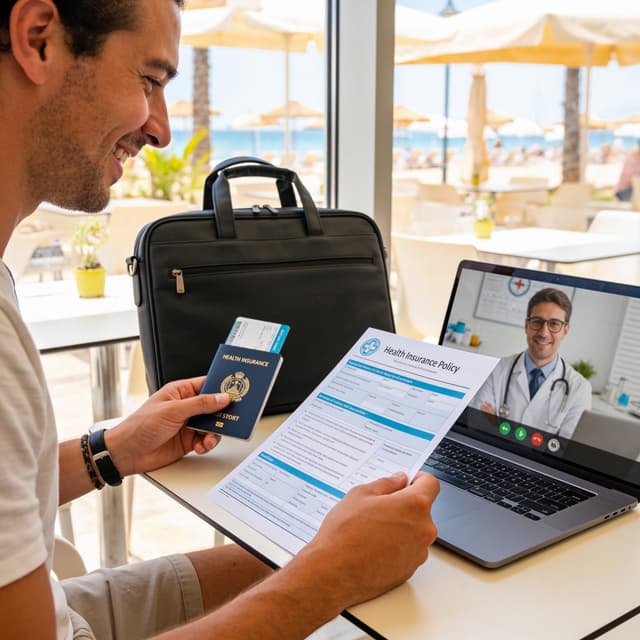
Online Doctor for Jet Lag Recovery in Spain: What Actually Helps

Medically Reviewed by Dr. Pedro Yelamo Vera, MD
Licensed Physician No. 484814280 · Official Medical College of Bizkaia (Spain)Last reviewed: 12 October 2026
A practical guide to jet lag recovery for travelers arriving in Spain: what an English-language video consultation can offer, proven strategies to reset your body clock, and the warning signs that mean it's not just jet lag.
You don't have to figure this out alone
Dr. Pedro Yelamo Vera is an independent, bilingual GP licensed in Spain. Book a 15-minute video consultation in English or Spanish for €50, with a private electronic prescription issued under Spanish law when clinically appropriate.
You landed in Spain feeling like your body clock is running on a different planet's time zone — wide awake at 3 a.m., foggy and useless by 3 p.m. That's classic jet lag, and for most travelers it resolves on its own within a few days. But when fatigue lingers, disrupts a work trip, or comes with symptoms that feel like more than tiredness, an English-language telemedicine consultation can help you sort out what's normal and what isn't, without navigating an unfamiliar local clinic to do it.
TL;DR
- Jet lag is a temporary circadian rhythm mismatch, not an illness — it typically improves within one day per time zone crossed.
- Light exposure timing, a temporary sleep schedule shift, and staying hydrated are the best-evidenced ways to speed recovery.
- An online doctor can assess whether your symptoms are ordinary jet lag or something else, and discuss options, subject to an individual medical assessment and only if clinically indicated.
- Sleep aids or other medication are never guaranteed in advance — any treatment depends on a proper assessment of your specific situation.
- This content is educational and not a substitute for medical advice. For emergencies in Spain, call 112.
Why this matters
Spain is a common long-haul landing point for travelers from North America, Asia, and Australia, often arriving for a short business trip or the first days of a holiday with no time to spare for feeling foggy. Jet lag is usually harmless, but travelers newly arrived in an unfamiliar country — without a regular doctor, unsure which local pharmacy to trust, and possibly worried a symptom might be something more serious — often want a quick, English-language second opinion rather than guessing based on a forum post.
Who this is for
This is for anyone who has just flown into Spain across multiple time zones — a consultant with back-to-back meetings the morning after landing, a family starting a two-week holiday, a digital nomad arriving to a new base — who wants to know whether what they're feeling is ordinary jet lag, and what actually helps.
What telemedicine can do for jet lag
Assess your symptoms in plain English
Describing grogginess, disrupted sleep, mild headache, or digestive upset is easier without a language barrier. A video consultation lets a doctor ask the right follow-up questions to distinguish ordinary jet lag from something that needs closer attention.
Offer an evidence-based recovery plan
A doctor can walk through light exposure timing, a gradual sleep-schedule shift, hydration, and caffeine/alcohol timing — the interventions with the best evidence behind them — tailored to your itinerary and how many time zones you crossed.
Review whether medication makes sense for your situation
Some travelers ask about short-term sleep aids or melatonin. A doctor can discuss whether that's reasonable for your circumstances — subject to an individual medical assessment and only if clinically indicated — rather than you guessing at a pharmacy counter.
Rule out look-alikes
Fatigue after a long flight can also come from dehydration, viral illness picked up in transit, or a medication interaction. A consultation helps confirm you're dealing with ordinary jet lag and not something else that happens to coincide with your arrival.
What telemedicine cannot do
- Guarantee a prescription for sleep aids or any other medication. Any treatment is subject to an individual medical assessment and only if clinically indicated.
- Replace emergency evaluation for red-flag symptoms. Chest pain, severe shortness of breath, confusion, or fainting are not jet lag and need immediate in-person care.
- Substitute for medical advice generally. This content is educational and not a substitute for medical advice. For emergencies in Spain, call 112.
When to skip self-treatment and seek in-person or emergency care
- Fever, especially with a cough or rash (rule out a travel-related infection, not jet lag)
- Chest pain or noticeable shortness of breath
- Confusion, fainting, or an irregular heartbeat
- Fatigue that hasn't improved after a week or more
- Leg swelling or pain after a long-haul flight (possible deep vein thrombosis)
Any of these warrant prompt in-person assessment rather than waiting it out. If you are unsure whether your situation is an emergency, err on the side of caution — in an emergency in Spain, call 112.
What actually helps: the short version
- Get outside in daylight at your destination's local morning, and dim light in the evening — light is the strongest cue for resetting your body clock.
- Shift your sleep schedule gradually toward local time rather than trying to force an abrupt switch.
- Stay hydrated and go easy on alcohol and caffeine in the first day or two.
- Avoid long daytime naps longer than 20–30 minutes, which can delay adjustment.
- Give it time — most people adjust within roughly one day per time zone crossed.
What to avoid
- Self-medicating with someone else's leftover sleep aids or unfamiliar over-the-counter products bought at a Spanish pharmacy without medical guidance.
- Assuming every symptom after a long flight is jet lag. Fever, chest pain, or leg swelling deserve evaluation, not assumption.
- Powering through days of unresolved fatigue instead of getting a medical opinion when something feels off.
FAQ
How long does jet lag usually last?
Most people adjust at roughly one day per time zone crossed, so a flight crossing six time zones might mean about six days to feel fully normal, though many feel largely better after two or three.
Can an online doctor prescribe something for jet lag?
A doctor can discuss whether any medication is appropriate for your situation, but any prescription is subject to an individual medical assessment and only if clinically indicated — nothing is guaranteed in advance.
Is jet lag ever a sign of something more serious?
Usually not, but fever, chest pain, leg swelling, or confusion are not typical jet lag symptoms and warrant medical evaluation rather than being written off as travel fatigue.
Should I try to stay awake or sleep when I land?
It depends on the time of day at your destination and your itinerary — a consultation can give you a plan tailored to your specific flight and schedule rather than generic advice.
What if I think I'm having a medical emergency?
This content is educational and not a substitute for medical advice. For emergencies in Spain, call 112 immediately rather than waiting for a video consultation.
One last thing
Jet lag is usually just your body catching up to a new clock, and for most travelers a few good habits are all it takes. But when fatigue doesn't fit the pattern, or you'd simply rather get an English-language opinion than guess, a quick video consultation can give you clarity without adding a language barrier to an already tiring trip.
This content is educational and not a substitute for medical advice. For emergencies in Spain, call 112.
Medical Citations & Sources
This content is written and reviewed by a licensed physician with reference to the following official health authorities.