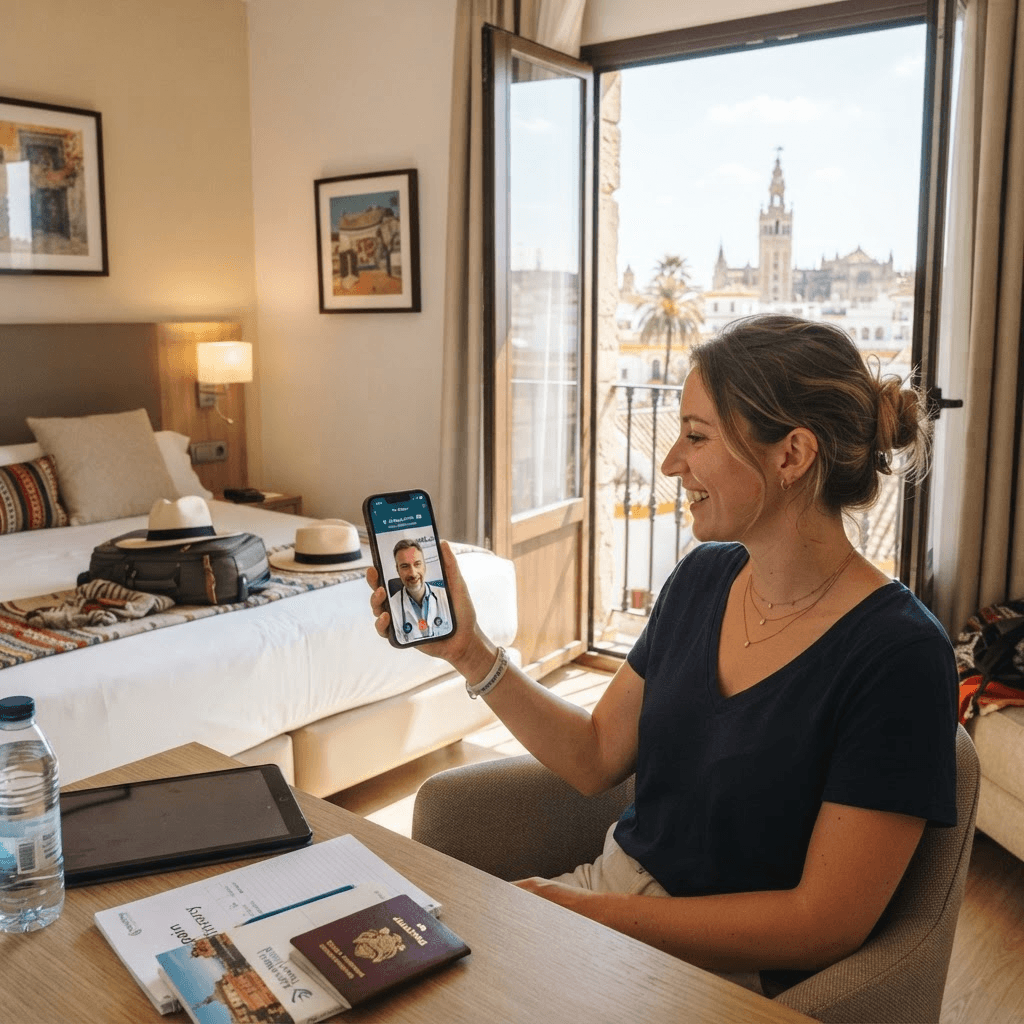
Need an English-speaking GP while living in Spain?
Living in Spain as an expat? See how an English-speaking GP video consultation works in 2026, what to prepare, and when local care is the better choice.

Written & Medically Reviewed by Dr. Pedro Yelamo Vera, MD
Licensed physicianLast Updated: 24 September 2026
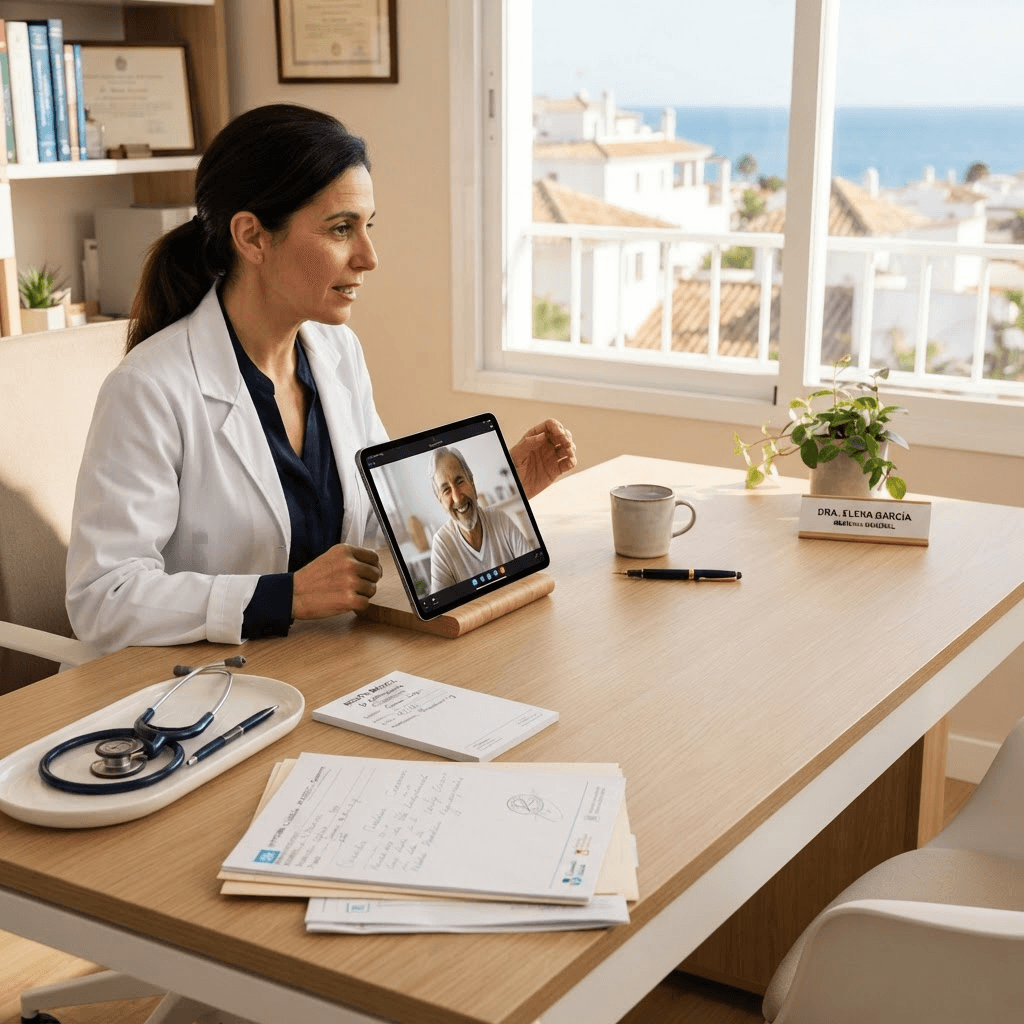
An English-speaking GP for expats in Spain is a licensed Spanish doctor who runs your consultation in English over secure video, assessing symptoms, ongoing conditions, lab results and prescription questions without a clinic visit or a translated conversation. This 2026 guide explains how those consultations work, what to prepare, and where the hard limits sit, so you can decide calmly whether video care fits your situation.
- An English-speaking GP for expats in Spain sees adults by secure video for non-emergency care.
- Dr. Pedro Yelamo Vera is licensed in Spain (No. 484814280) and consults in English and Spanish.
- Prescriptions follow a genuine assessment; nothing is guaranteed and emergencies belong to 112.
- Book before medication runs out and keep a one-page medicine list within reach.
Why this matters
Spain's public healthcare is good, but it is built around Spanish paperwork and Spanish appointment lines. If you arrived on a work visa, a digital nomad permit or retirement plans, the usual first steps — registering for a health card, finding a local doctor, waiting for a slot — can take weeks, and the consultation itself may happen in fast Spanish. When a medication is running low or a symptom has lingered for a month, weeks of admin is not a neutral delay.
Many expats first meet the Spanish system at exactly the wrong moment: the pharmacy counter, holding an empty box. Our guide to how to get a prescription online as an expat in the EU shows what that process looks like when it is planned instead of improvised.
A video GP does not replace the Spanish public system, and it does not handle emergencies. What it gives you, in 2026, is an unhurried assessment in your own language, usually within a day of asking.
Need an English-speaking GP while living in Spain? The direct answer
Yes. Adults living in Spain can book a private video consultation with a Spanish-licensed general practitioner who consults in English, use it for a non-emergency concern, and receive a clear plan afterwards. In 2026 the practical route looks like this:
- Rule out urgency. Chest pain, trouble breathing, heavy bleeding, stroke signs or anything rapidly worsening belongs to 112 or the nearest emergency department, not a video call.
- Write a one-page summary of the concern, your medicines with doses, allergies and any recent results.
- Book an English-language video slot with a licensed GP and confirm the time against your calendar.
- Join from a private, well-lit space with a stable connection and your documents nearby.
- Confirm next steps before the call ends — what to do today, what to watch for, whether follow-up is needed.
- Plan follow-up before you need it, especially for ongoing conditions and repeat prescriptions.
The rest of this guide fills in the detail behind each step.
Step 1: decide whether the concern is routine
Video consultations are for non-emergency care: a symptom that has persisted, a medicine question, a result you need explained, follow-up on a condition you already know you have. If you are unsure how serious something is, err towards local emergency care. An online GP can always tell you afterwards that the concern needed a clinic — you cannot say the same in reverse.
Step 2: put your health summary on one page
List what you take — name, strength, how often — including over-the-counter products and supplements. Note allergies with what actually happened, conditions you have been told you have, and the date your current problem began. Keep medicine boxes or clear photos beside you during the call. If you do not know a dose, say so plainly; do not guess it.
Step 3: book an English-language video slot
Dr. Pedro Yelamo is an EU-licensed GP in Spain (No. 484814280) who provides confidential GP video consultations in English and Spanish for adults in Spain and elsewhere in the EEA. The stated response time is under 24 hours, and his Google and Doctoralia reviews hold a 5.0 rating across more than 30 reviews. Check the available times rather than assuming an immediate appointment, and choose the language in which you can describe your symptoms most precisely.
Step 4: join from a private, well-lit space
Sit with light in front of you, close interrupting apps, and plug in your device. Ten to fifteen minutes of preparation is usually enough. If someone helps with your care, decide beforehand whether they join the call. Privacy is part of clinical quality — a consultation taken from a shared office or a busy café limits what you can discuss.
Step 5: confirm next steps before the call ends
Repeat the plan back in your own words: what to do now, which warning signs should prompt urgent care, and whether a prescription, certificate or referral was discussed. A video consultation does not guarantee a prescription, a certificate, or a particular outcome; any prescribing decision follows an individual assessment and applies only where clinically appropriate.
Step 6: arrange follow-up before you need it
A single call solves a single problem. For a chronic condition, ask before the call ends how a review would be arranged next time, so renewal does not become a scramble. The preparation checklist most patients use is described in how to prepare for an online GP consultation — it applies to expats and visitors alike.
What a video GP can assess — and what needs in-person care
| Concern | Usually suitable for video | Why |
|---|---|---|
| Ongoing symptom, no red flags | Yes | History and visual assessment carry most of the decision |
| Medicine questions, side effects, refills | Yes, case by case | Depends on the medicine, its rules and your history |
| Lab result explanation | Yes, if you hold the report | The GP can read and explain results you already have |
| Certificates and sick notes | Assessment decides | Issued only where clinically appropriate, never on request alone |
| Anything needing examination | No | Palpation, listening to the chest and procedures need a clinic |
| Emergencies | Never | Call 112 or attend the nearest emergency department |
The table is a map, not a promise. The GP decides during the call whether video is sufficient for your specific situation — that judgment is the point of the assessment.
Prescriptions: assessment first, paperwork second
Where clinically appropriate, following a genuine evaluation, a Spanish prescription may be issued for an adult patient — including cross-border e-prescriptions valid across the EEA. Three limits matter in 2026. First, the decision belongs to the doctor after the assessment, never to the booking form. Second, dispensing depends on the pharmacy, medicine availability and local rules, so do not plan travel around an expected prescription. Third, controlled substances and some specialist medicines fall outside what a video GP can manage, and the doctor will tell you so rather than improvise.
If you take a medicine for blood pressure, thyroid, asthma or a similar stable condition, bring the original box or a photo of the label. That single detail prevents most prescription discussions from stalling.
If your symptoms become urgent while you wait
An online appointment is never a reason to wait out a developing emergency. In Spain, and across the EU, 112 connects you to emergency services with multilingual support. Warning signs that need immediate care include:
- Chest pain or pressure, especially with sweating or nausea
- Sudden weakness or numbness on one side, or trouble speaking
- Difficulty breathing or a severe allergic reaction
- Heavy or uncontrolled bleeding
- A sudden, worst-ever headache
Save 112 in your phone the day you arrive in Spain, not the day you need it.
Why expat access to Spanish healthcare varies
- Residency and registration. Longer-term residents can register for the public system; newcomers and some permit holders face waiting periods.
- Private insurance. Many expats hold private policies whose rules differ on remote consultations and reimbursement — check your policy before booking, because the GP cannot approve a claim on the insurer's behalf.
- Language. Public consultations run in Spanish (and co-official languages); interpreters exist but are not guaranteed at short notice.
- Appointment supply. Availability differs by region and season, which is why private video care is often the fastest first assessment for a non-emergency.
- Where you live. If you split the year between countries, a Spanish-licensed GP who consults across the EEA may fit better than a single-country service.
None of this makes the public system wrong — it makes it a different tool. Match the tool to the problem.
Questions expats ask
Can I use an English-speaking video GP without a Spanish health card?
Yes. Private video consultations do not depend on public-system registration in 2026. You identify yourself as for any private medical service, and the doctor assesses the concern in English.
Will a video GP prescribe my regular medication?
Possibly, but never automatically. Where clinically appropriate, following a genuine evaluation, a Spanish prescription may be issued, including e-prescriptions valid across the EEA. Controlled substances are excluded, and dispensing always depends on the pharmacy.
How fast can I get an appointment?
The stated response time is under 24 hours — a response, not a guaranteed slot time. If your need cannot wait that long, use local urgent care instead of a video booking.
One last thing
The expats who get the most from video GP care in 2026 are not the ones with perfect medical folders. They are the ones who write one honest page — what changed, when it changed, what they take — and book before the situation becomes urgent. Dr. Pedro Yelamo Vera's consultations are unhurried by design; the calm part is your half of the preparation.
FAQ
Can expats in Spain see an English-speaking GP online in 2026?
Yes. Private video consultations with a Spanish-licensed GP are open to adults living in Spain, regardless of public-system registration. The doctor assesses whether remote care suits your concern.
Does Dr. Pedro Yelamo Vera really consult in English?
Yes. Consultations run in English or Spanish, whichever you can describe your symptoms in most precisely. He is a native Spanish speaker with C2 English.
Is an online prescription from a Spanish GP valid across the EU?
A Spanish e-prescription may be issued where clinically appropriate and is valid across the EEA under cross-border healthcare rules. Individual pharmacies still decide what they can dispense.
Can a video GP issue a medical certificate?
A certificate can follow a genuine assessment where clinically appropriate. It is never guaranteed, and the organisation receiving it decides whether to accept it.
What if I need a physical examination?
Then a video consultation is the wrong tool. The GP will say so and point you to in-person care rather than stretch a remote assessment beyond its limits.
Is this service suitable for emergencies?
No. Online GP consultations are not an emergency service. Call 112 in Spain or go to the nearest emergency department for anything urgent.
How quickly will I hear back after booking?
The stated response time is under 24 hours. Treat it as a planning figure, not a guaranteed appointment time, and use local care if you cannot wait.
Related guides
Medical Citations & Sources
This content is written and reviewed by a licensed physician with reference to the following official health authorities.