Digital Nomad Health Insurance for Spain's Digital Nomad Visa: Requirements Checklist

Medically Reviewed by Dr. Pedro Yelamo Vera, MD
Licensed Physician No. 484814280 · Official Medical College of Bizkaia (Spain)Last reviewed: 21 October 2026
Spain's Digital Nomad Visa insurance rule is stricter than most applicants expect: no copayments, no waiting periods, a Spain-authorized insurer, and a properly worded certificate. Here is what consulates actually check before they approve.
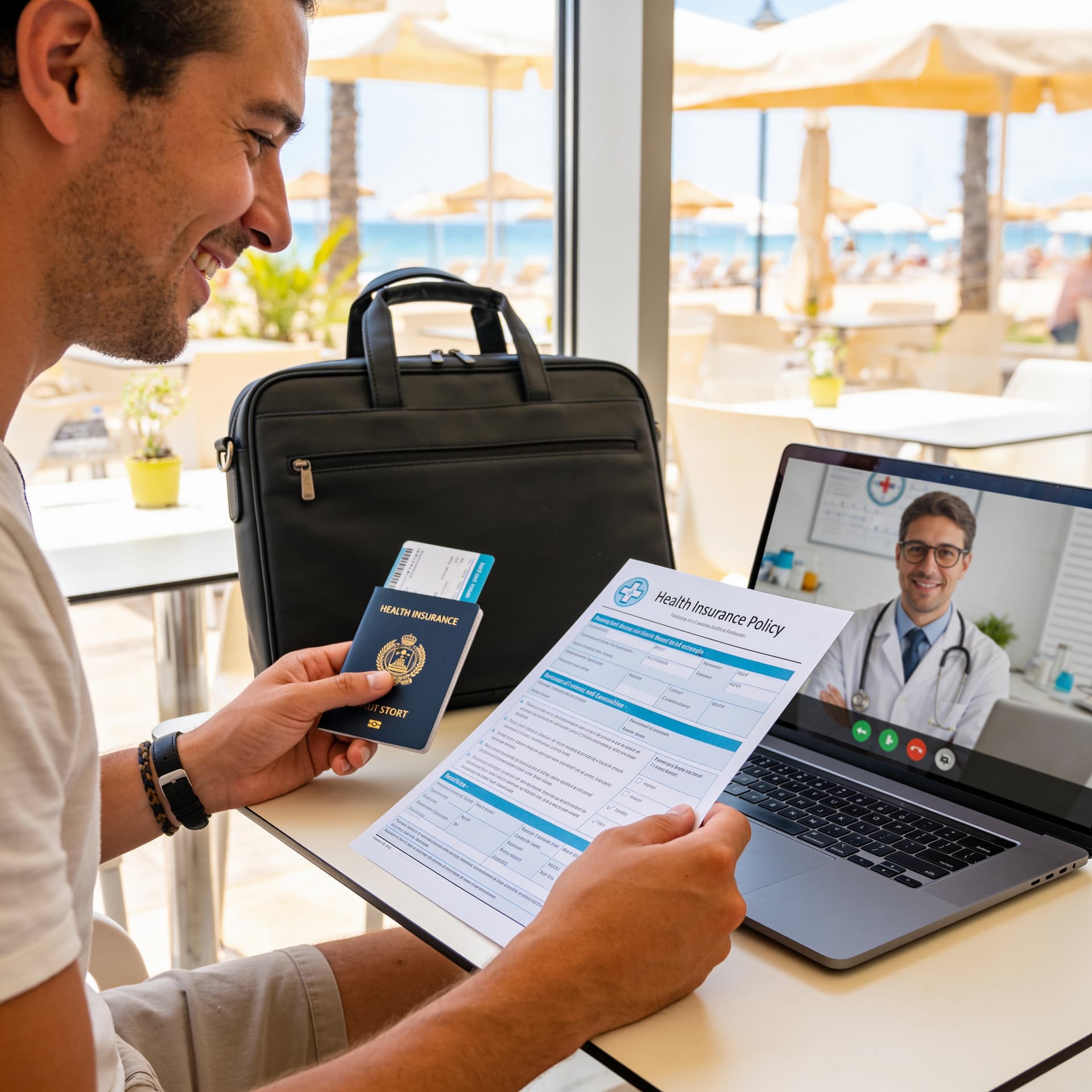
You don't have to figure this out alone
Dr. Pedro Yelamo Vera is an independent, bilingual GP licensed in Spain. Book a 15-minute video consultation in English or Spanish for €50, with a private electronic prescription issued under Spanish law when clinically appropriate.
Spain's Digital Nomad Visa is for people working remotely for clients or employers outside Spain. Health insurance is one of the rules that most often holds an application back. Many applicants find that their usual nomad or travel policy is not enough. This guide explains what the rules ask for, what to check in your insurance plan, and how to prove your cover.
- You need private health insurance from an insurer allowed to operate in Spain. Travel insurance is not accepted.
- Consulates usually ask for no copayments and no limit on cover. Many also ask for no waiting periods.
- The cover must last for the whole period you apply for. Each consulate publishes its own checklist, so read the one that handles your application.
Why health insurance matters so much
Spanish law asks every visa holder in this category to have public or private health insurance with an insurer authorised to operate in Spain. Consulates and the immigration office then check the policy in detail.
The checklists we have read from Spanish consulates ask for these points:
- no copayments (copagos): the policy pays 100% of medical costs, in and out of hospital;
- no waiting periods (carencias) and no limit on cover, in many consulates;
- cover for the whole period of your visa or permit;
- repatriation, in some consulates;
- an insurer listed in the register of Spain's insurance authority, the Dirección General de Seguros y Fondos de Pensiones (DGSFP).
The exact list differs between consulates. Read the checklist of the consulate that handles your visa before you buy a policy.
Who this guide is for
- Remote employees, freelancers and founders working remotely from Spain.
- Visa holders renewing their permit or applying for their residence card (TIE).
- Family members joining you, who need their own cover.
Quick answer: health insurance checklist
| Point to check | What consulates usually look for |
|---|---|
| Insurer | Authorised to operate in Spain |
| Type of policy | Health insurance, not travel insurance |
| Copayments | None |
| Waiting periods | None, in many consulates |
| Limits | No limit on cover, in many consulates |
| Duration | The whole period of the visa or permit |
| Proof | A certificate from the insurer, in Spanish or officially translated |
If you pay into social security in a country that has a social security agreement with Spain, that cover may count instead. Ask the consulate which certificate it accepts.
Travel, short-term and international policies
A travel policy is built for short trips. It pays for emergencies and getting you home, often with excess payments and a time limit. Consulates say plainly that travel insurance is not valid for this visa.
International health insurance can be a good fit, but only if the insurer is authorised to operate in Spain and the policy meets the points above. A worldwide plan from an insurer with no Spanish authorisation does not meet the rule, even if it pays you back later. Short-term plans that you renew each month are risky too, because the cover must last for the whole period you apply for.
What to check in your insurance plan
Health insurance plans for people working remotely in Spain differ a lot. Before you buy, check that the plan covers:
- GP visits and urgent care;
- specialist visits, tests and scans;
- hospital stays and surgery;
- pregnancy care, if it applies to you;
- medical repatriation, if your consulate asks for it.
Ask the insurer in writing whether the policy has any copayment, excess, waiting period or cover limit. If it has one, ask whether a version without it exists.
The insurance certificate
Most consulates ask for a certificate from the insurer. It usually states:
- your name and the policy number;
- the start and end dates, covering your whole visa period;
- that the insurer is authorised to operate in Spain;
- that there are no copayments, and, where asked, no waiting periods or limits.
Visa documents must be in Spanish or come with an official translation.
Pre-existing conditions
Declare any health condition in the insurer's health questionnaire. Some insurers cover stable pre-existing conditions after they review it. Others exclude them, and then you pay for that care yourself.
Once you are in Spain
Your insurer will have its own network of doctors and clinics. A private online GP can also help with everyday problems while you settle in:
- Video consultations: for urgent, non-emergency problems, from anywhere in Spain. Consultations run every day, 07:30–20:30 (Spain time).
- Prescriptions: a private electronic prescription under Spanish law, issued only where clinically appropriate, following a genuine evaluation. It is for pharmacies in Spain.
- Medical certificates: issued only when a genuine assessment supports them. See our guide to medical certificates for Spanish visas.
- Blood tests: lab requests and results explained in English. Read our guide to blood tests in Spain.
Keep the invoice from each visit. Your insurer may pay it back, depending on your policy. In an emergency, call 112.
Frequently Asked Questions
Does travel insurance count as health insurance for the visa?
No. Consulates state that travel insurance is not valid. You need a health insurance policy from an insurer authorised to operate in Spain.
Can pre-existing conditions be covered?
Sometimes. Declare them in the health questionnaire. Some insurers authorised in Spain cover stable conditions after reviewing your answers.
Does my partner or child need their own policy?
Yes. Each family member on the application needs health cover that meets the same rules.
Can I use my home country's public health cover?
Possibly, if your country has a social security agreement with Spain and you keep paying into it. Ask the consulate which certificate it needs.
Medical Citations & Sources
This content is written and reviewed by a licensed physician with reference to the following official health authorities.