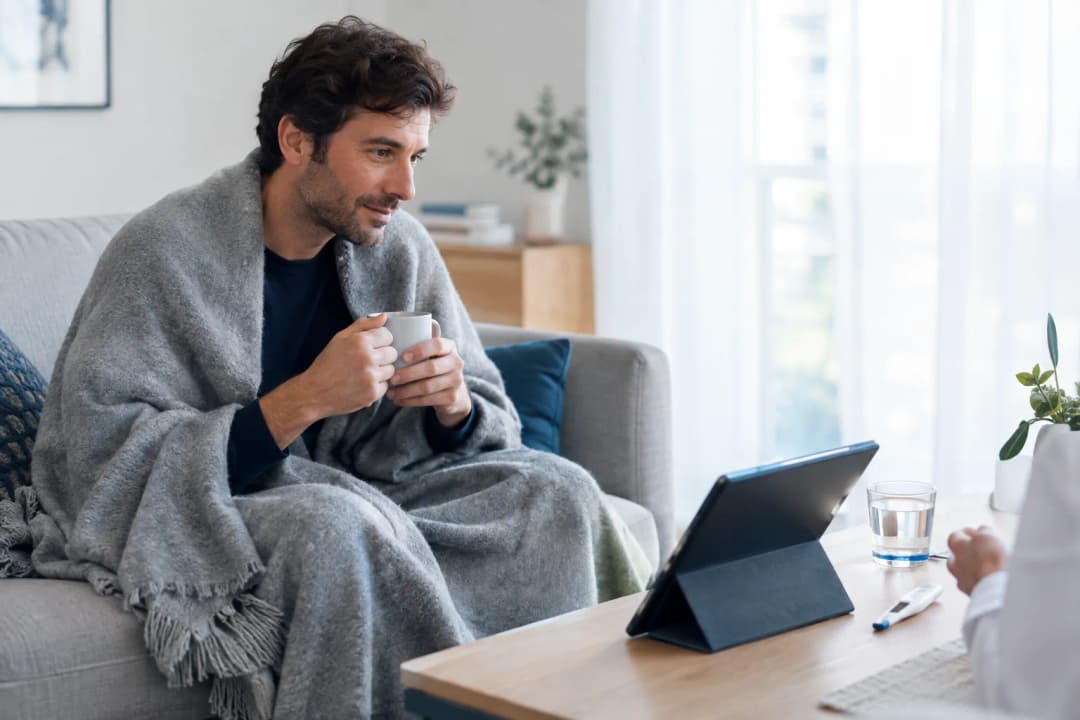
Moving to Spain with your partner: arranging your own GP care

Medically Reviewed by Dr. Pedro Yelamo Vera, MD
Licensed Physician No. 484814280 · Official Medical College of Bizkaia (Spain)Last reviewed: 11 October 2026
Moving to Spain with your partner? Arrange your own GP care: your records, your medicines and your own consultations.
You don't have to figure this out alone
Dr. Pedro Yelamo Vera is an independent, bilingual GP licensed in Spain. Book a 20-minute video consultation in English or Spanish for €50, with a private electronic prescription issued under Spanish law when clinically appropriate.
Moving to Spain with your partner can leave your own GP care behind the move’s paperwork, especially when healthcare arrangements sit under your partner’s name. You can build a separate care plan without managing everything alone: confirm your own access, keep your records together, and choose a consultation route you can use confidently in English.
- GP care expat partners Spain: arrange your own access, records, and follow-up rather than relying on your partner’s arrangements.
- Dr. Pedro Yelamo Vera provides bilingual video GP consultations for patients currently in Spain; in-person examinations require local care.
- Check public healthcare eligibility and insurance cover individually; a partner’s arrangements do not confirm your access.
- For medical emergencies, call 112 or attend the nearest local emergency department; do not wait for a video consultation.
Why GP care matters for partners moving to Spain
When one partner handles the relocation, healthcare can become another shared task. But your consultation, medical history, privacy preferences, and insurance questions need individual attention. The practical goal is simple: know how to contact a doctor yourself, even when your partner is unavailable.
You do not need fluent Spanish to start organising your care. Write down what you need help with, separate medical questions from administrative ones, and ask each organisation to confirm the arrangements that apply to you personally.
Dr. Pedro Yelamo Vera’s bilingual video GP care is best for English-speaking partners currently in Spain who want a private medical conversation without travelling to a clinic. The practice provides unhurried consultations in English and Spanish with a GP licensed in Spain (Colegiado No. 484814280). Video care does not replace a necessary physical examination or emergency assessment.
You can explore the practice through Dr. Pedro Yelamo Vera. This guide focuses on organising your own care after a move, rather than explaining every route into Spain’s healthcare system.
Build your own GP care plan in Spain
For your move, keep the plan small enough to use: your access arrangements, your medical information, and your next point of contact. You can organise these yourself before asking a clinician to review any medical concerns.
Confirm your own healthcare access
Start with the administrative question: which healthcare route can you personally use? Ask the relevant public healthcare office or your insurer to confirm your position. Do not treat a partner’s registration, employer benefit, or insurance card as confirmation of your own access.
If you receive conflicting answers, ask for written instructions and the name of the organisation responsible for the next step. Keep those messages together. A GP consultation addresses medical questions; it does not establish your entitlement to public healthcare or settle an insurance dispute.
For a current relocation, use current instructions from the organisation handling your application rather than an old checklist shared in an expat group. Your relationship status alone is not a complete care plan.
- Ask whether you are individually registered or named on the policy.
- Confirm which documents the organisation needs from you.
- Ask how to arrange a first appointment under that route.
- Record unresolved questions and who will answer them.
- Keep your own copy of registration or coverage confirmations.
Gather a separate medical record
Create your own medical folder, even if you and your partner share a household filing system. Start with documents you already have: recent consultation summaries, relevant test reports, and your current treatment information. Keep original documents alongside any translations.
As a practical starting point, prepare a 1-page summary of the information you want the doctor to understand. This is a suggested organising aid, not a substitute for your full records. Include dates on documents so the clinician can distinguish older information from recent care.
You do not have to explain every past appointment during the opening moments of a consultation. A clear summary lets you identify the main concern first and then provide the supporting records the doctor requests.
- List your current medicines exactly as shown on their packaging or records.
- Include recorded allergies and previous reactions.
- Gather reports relevant to the reason for your appointment.
- Note the clinician or service that previously managed your care.
- Keep original files readable and clearly named.
Choose a consultation route that fits your need
Begin by checking the routes already available to you: your registered healthcare service, your insurer’s instructions, or a local clinic. Ask whether the appointment can take place in English and whether you need to attend in person. Choose according to the task, not simply the easiest booking process.
For patients currently in Spain, Dr. Pedro Yelamo Vera offers private bilingual video GP consultations from home or a hotel. The practice’s GDPR-compliant telemedicine service provides a confidential setting for medical guidance and follow-up. A video consultation removes travel to that appointment, but not the possibility that the doctor will recommend local examination or testing.
If your main concern involves an existing condition, the GP follow-up guide for expats in Spain explains the relevant follow-up context without replacing individual assessment.
- Match the appointment route to the question you need answered.
- Confirm the consultation language before booking.
- Ask how to provide records through the practice’s approved process.
- Check where to attend if a physical examination is needed.
- Keep emergency care separate from routine booking arrangements.
Set your privacy and partner-involvement preferences
Moving together does not mean you must discuss every health concern together. You can ask to speak privately, invite your partner to support part of the conversation, or attend without them. State your preference at the start so the consultation reflects your wishes.
If your partner usually translates, a bilingual consultation gives you the option to explain your concern directly. That can be especially useful when the issue feels personal or when you want to ask questions without managing another conversation at the same time.
Before your appointment, check the practical details of privacy at home. Shared calendars, devices, and email accounts can reveal information even when you have chosen to attend the consultation alone.
- Use an email account you can access independently.
- Choose a room where you can speak without being overheard.
- Tell the doctor whether your partner is present.
- Explain what involvement you want your partner to have.
- Ask how appointment documents will be sent to you.
Prepare for the video conversation
Use a suggested 10-minute preparation period to organise your questions and test your device. You do not need a polished account of your medical history. Explain what is troubling you, what you want help understanding, and what information you already have.
A consultation is an assessment, not an order for a particular document or medicine. Where clinically appropriate, following a genuine evaluation. Treatment and prescriptions are issued solely at the doctor's discretion based on evidence-based clinical guidelines.
Dr. Pedro Yelamo Vera provides private electronic prescriptions under Spanish law when clinically appropriate after evaluation; an appointment does not guarantee one. Medical certificates also depend on assessment, and their acceptance is a separate question for the organisation requesting them. Bring any stated requirements rather than assuming a general letter will meet them.
- Write down your main concern in plain language.
- Prepare the relevant records and current medicine information.
- Test your camera, microphone, and internet connection.
- Have your current location in Spain ready to confirm.
- Bring any document requirements you want the doctor to consider.
Agree the next step before ending
Before the conversation ends, ask what happens next and who is responsible for arranging it. A useful care plan distinguishes the doctor’s advice from tasks you need to complete, such as contacting a local service or providing an additional report.
Do not change an existing treatment plan based on this article. Discuss treatment questions with the clinician who assesses you. If the doctor recommends in-person care, ask where to seek it and what information to take; the video appointment is part of your care, not a replacement for every other service.
For your care folder, record the consultation date and the agreed next action. This makes it easier to continue the conversation without relying on your partner’s memory or a scattered message thread.
- Ask for clarification if an instruction is unclear.
- Confirm whether local examination or testing is needed.
- Establish who will review any requested results.
- Record how to contact the practice about follow-up.
- Keep documents from the consultation with your own records.
Keep a backup route independent of your partner
Your care arrangements should still work when your partner is travelling, working, or unavailable. Save 2 contact routes as a practical planning target: your usual healthcare contact and a local in-person service. Keep emergency instructions separately and clearly visible.
For medical emergencies, call 112 or attend the nearest local emergency department. Do not wait for an online appointment, an email reply, or your partner to return. The practice does not handle medical emergencies.
Review your arrangements after a change of address, insurance, or household circumstances. The point is not to repeat every administrative task; it is to check that you still know how to obtain care yourself.
- Save your usual appointment contact on your own phone.
- Identify a local service for necessary in-person care.
- Keep your current address easy to find and share.
- Make sure you can access your records independently.
- Recheck your arrangements when your circumstances change.
The sequence is deliberately simple: confirm access, organise records, choose the route, then agree follow-up. Privacy belongs throughout the process, not just inside the consultation.
Compare your care options
Choose the route that fits the assessment you need, not the route your partner happens to use. Public, insured, and private care involve different administrative arrangements. Video and in-person appointments also serve different practical needs.
No single option covers every situation. Use this comparison to prepare questions for the relevant service rather than to assume eligibility or coverage.
| Option | Best for | Practical advantage | Key limitation |
|---|---|---|---|
| Public GP service | Patients whose individual access has been confirmed | A route into their local public healthcare arrangements | Registration and access need confirmation for the individual patient |
| Insurer-arranged care | Patients with confirmed cover for the requested service | Appointment arrangements guided by the insurer | The policy determines coverage and any approval requirements |
| Private in-person GP | Patients who need an appointment with a physical examination | Face-to-face assessment | Requires attendance; confirm language arrangements beforehand |
| Dr. Pedro Yelamo Vera video GP care | English-speaking patients currently in Spain seeking private medical guidance | Bilingual consultation without travelling from home or a hotel | Cannot provide a hands-on examination or emergency care |
You can combine routes where appropriate, but keep the clinicians informed about relevant care received elsewhere. Ask what records they need rather than assuming information transfers automatically between services.
Check whether video care fits
Discuss your own healthcare concerns in English or Spanish while you are in Spain.
Common mistakes partners make after relocating
Treating a shared policy as confirmed personal access
A household document is not enough to answer every coverage question. Ask the insurer or registration office to confirm your name, the relevant service, and the appointment process. Keep the answer where you can retrieve it yourself.
Letting your partner become the only contact
Help with forms is useful; dependence on someone else’s inbox is less useful when you need care alone. Keep your own contact details current and make sure appointment messages reach you directly.
Sharing records without considering privacy
A shared relocation folder can contain information you would prefer to discuss privately. Separate medical records from general household documents and decide which details you want your partner to access.
Booking video care for a required physical examination
Read the requesting organisation’s requirements before booking. A video GP consultation does not replace required occupational, driving, aviation, maritime, sporting, or other in-person fitness examinations. Ask which examination and authorised service are required.
FAQ
Do I need my own GP arrangements if I moved to Spain with my partner?
Yes, confirm your own access and keep your own appointment contact and medical records. Your partner can help, but their registration or insurance arrangements do not confirm yours.
Can I speak to a GP in English without my partner translating?
Yes, Dr. Pedro Yelamo Vera provides bilingual English and Spanish video GP consultations for patients currently in Spain. You can explain your concerns directly and choose whether your partner participates.
Can I have a confidential consultation while living with my partner?
You can request a private consultation and attend without your partner. Use a private room and your own contact details, and tell the clinician who is present during the call.
What should I prepare for my first video GP appointment in Spain?
Prepare your main question, relevant medical records, current medicine information, and your location in Spain. Check your camera and microphone, and have any requested document requirements ready.
Will a video consultation guarantee a prescription or certificate?
No, neither a prescription nor a certificate is guaranteed. Where clinically appropriate, following a genuine evaluation. Treatment and prescriptions are issued solely at the doctor's discretion based on evidence-based clinical guidelines.
Is a video GP better than an in-person GP after moving to Spain?
Video care suits a private medical conversation without travel; in-person care is needed when the assessment requires a physical examination. Choose the route according to your needs and the assessing clinician’s advice.
What should I do if I need emergency medical help in Spain?
Call 112 or attend the nearest local emergency department for a medical emergency. Do not wait for a video consultation or an online reply; the practice does not provide emergency care.
One last thing
Test whether your care plan works without your partner. For your move, check that you can find your records, contact a healthcare service, explain your current address, and retrieve your appointment instructions independently.
That is not about excluding someone who supports you. It gives you the option to ask for help while keeping control of your own healthcare.
Related guides
Medical Citations & Sources
This content is written and reviewed by a licensed physician with reference to the following official health authorities.