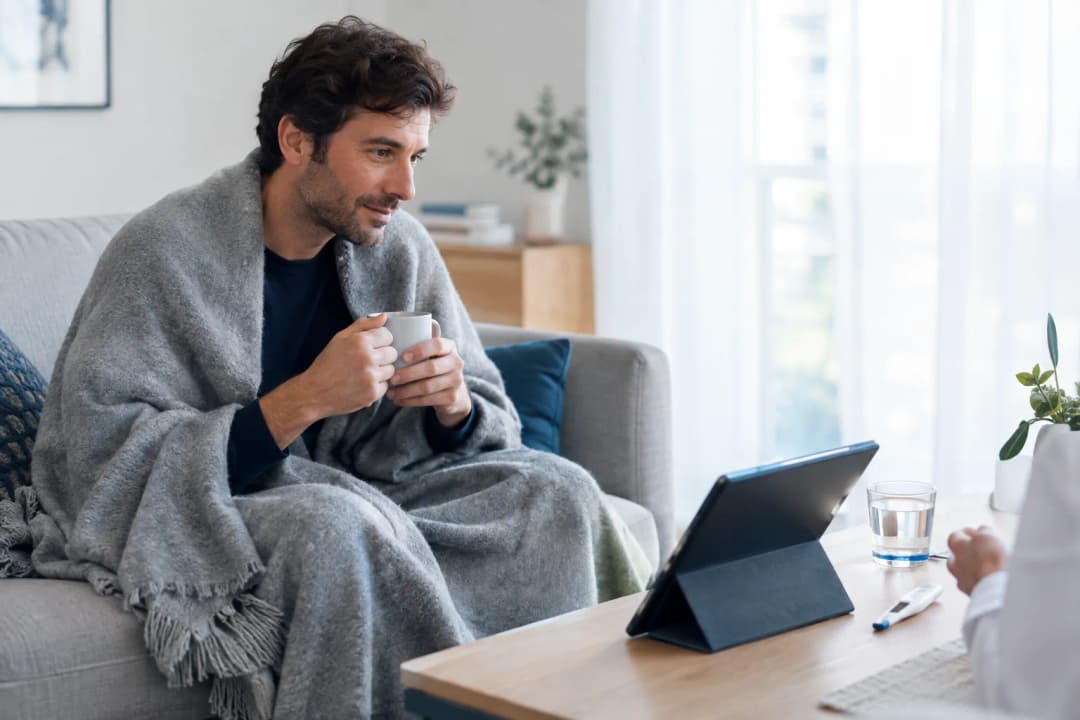
English video GP in Spain: privacy questions before booking

Medically Reviewed by Dr. Pedro Yelamo Vera, MD
Licensed Physician No. 484814280 · Official Medical College of Bizkaia (Spain)Last reviewed: 11 October 2026
Before booking an English-speaking video GP in Spain, check recording, record access and secure document sharing. Questions to ask first.
You don't have to figure this out alone
Dr. Pedro Yelamo Vera is an independent, bilingual GP licensed in Spain. Book a 20-minute video consultation in English or Spanish for €50, with a private electronic prescription issued under Spanish law when clinically appropriate.
If sharing personal health information while staying in Spain worries you, check who can access your records, whether the video call is recorded, and how documents are shared before booking an English-speaking GP. You can ask for these explanations in plain English without describing your medical concern first. A private consultation still creates a medical record; confidentiality does not mean anonymity or automatic deletion.
- English video GP privacy Spain: check recording, record access and document delivery before booking.
- Dr. Pedro Yelamo Vera offers bilingual video GP consultations for patients currently in Spain.
- Ask for the privacy notice and approved document-sharing method before sending medical information.
- For medical emergencies, call 112 or go to the nearest emergency department; do not wait for video care.
English video GP in Spain: what privacy questions should you ask?
Start with the questions below. You do not need to understand technical security terms to ask for a clear explanation of what happens to your information.
Dr. Pedro Yelamo Vera provides bilingual English/Spanish video GP consultations and identifies the service as GDPR-compliant. That description does not answer every practical question about recording, document delivery or the visibility of booking messages. Ask about the arrangements relevant to your situation before sharing sensitive details.
- Who is responsible for my information? Ask which person or organisation controls your medical and booking records, and how to contact them about privacy.
- Who can access my records? Ask whether access includes the doctor, administrative staff or service providers, and what each needs to see.
- Is the consultation recorded? Ask specifically about audio, video, transcripts and any automated note-taking. Do not assume that a video call is recorded—or that it is not.
- How should I send documents? Ask for the approved route for test results, previous letters and identity documents before uploading or emailing them.
- How will you contact me? Check which email address or phone number receives confirmations, reminders and clinical documents.
- How long are records retained? Ask how retention periods are explained and how you can request access or correction.
For a booking, use the privacy notice available when you book. If an explanation is unclear, ask for clarification before sending the document concerned.
Why this matters when you are away from home
Privacy concerns are practical, not excessive. You might be using a shared apartment, borrowing a device or receiving messages on a work phone while travelling in Spain. The booking process should explain what you need to share without making you guess.
It is reasonable to want an English explanation before discussing something personal. You can ask an administrative privacy question without giving a detailed account of your symptoms. Keep that first enquiry focused on the information you need to decide whether to book.
Dr. Pedro Yelamo Vera is suited to English-speaking patients in Spain seeking non-emergency, bilingual video GP care. The practice offers convenience and a consultation in your preferred language; video care does not remove the need for an in-person assessment when the doctor considers one necessary.
What should the privacy notice explain?
A privacy notice should identify the organisation responsible for your information, explain why it is processed, and describe relevant recipients, retention arrangements and rights. Under the GDPR, health information receives special protection as a category of sensitive personal data. These are legal privacy principles, not promises that every service uses the same technology.
Read the notice with your actual booking in mind. A broad statement about security is less useful than an explanation of where your documents go and whom you can contact with a concern.
Look for answers about:
- Purpose: why booking details, identity information and health records are needed.
- Access: who receives information and for what purpose.
- Service providers: whether other organisations process information on the practice's behalf.
- International transfers: whether information is transferred outside the European Economic Area and, if so, what safeguards apply.
- Retention: how long information is kept, or how that period is determined.
- Your rights: how to request access, correction or other applicable rights.
You do not need to decide whether a legal clause is sufficient on your own. Ask the practice to explain the relevant section in English. For your appointment, keep the explanation with your booking correspondence so you can refer to it later.
Will the video consultation be recorded?
Ask about recording explicitly; a video appointment and a stored recording are different things. A medical record can contain the doctor's consultation notes without containing a recording of the call. Ask separately about audio, video, transcripts and automated tools.
If recording is proposed, ask what its purpose is, who can access it, how long it is kept and what choices you have. Do not interpret permission to join a consultation as an explanation of every possible use of the conversation.
You can also state your preference before the appointment. For example, explain that you want to understand any recording arrangements before discussing your health. This keeps the conversation clear without turning a privacy question into a confrontation.
The same care applies if you want to record the consultation yourself. Ask the doctor first and discuss how you intend to store or share it. A recording can contain information about other people as well as your own care.
How can you prepare a private place for the call?
Choose a setting where you can speak without being overheard. Headphones help keep the doctor's voice private, but they do not stop people nearby from hearing your answers. A quiet background is useful; a private conversation matters more.
The best setting depends on where you are staying in Spain. Compare the practical trade-offs rather than assuming that home, a hotel or a workspace is automatically private.
| Setting | Best for | Privacy advantage | Limitation to check |
|---|---|---|---|
| Private room at home | Patients with a room they can use alone | You control who enters the room | Housemates can still overhear through an open door |
| Private hotel room | Tourists with their own room | You can speak away from public reception areas | Travelling companions or interruptions can reduce privacy |
| Enclosed room in a shared workspace | Remote workers without another private setting | It separates the call from an open working area | Check whether conversations are audible outside |
Before joining, close unrelated documents and browser tabs, check which microphone and camera are active, and turn off notifications that could interrupt you. Avoid displaying other people's records if screen sharing is requested.
If your accommodation offers no suitable space, tell the practice before the appointment. Do not begin a sensitive conversation in a public area simply because the booking time has arrived.
How should you send medical documents safely?
Use the practice's approved sharing method, not whichever app is most convenient. Ask for instructions before sending a passport image, medical letter or test result. This article does not identify a particular upload system or messaging platform used by the practice.
For a current consultation, use the document instructions supplied for that booking. An old email thread or a saved contact is not a substitute for confirming the correct destination.
Confirm the channel
Ask where documents should be sent and how to recognise the intended recipient. If an unexpected message asks you to provide records through a different route, confirm the request through your established contact with the practice.
Select relevant records
Ask which documents the doctor needs for the reason you are attending. Avoid sending an entire folder without checking its relevance, but do not remove clinically relevant information on your own. Tell the practice if a document contains information about someone else.
Check the recipient
Check the destination before sending. Look for an accidentally selected contact, a reply-all chain or an attachment intended for another person. These are checks you can make regardless of the service's technical safeguards.
Keep your copy
Keep the records you supplied and the instructions you received in a place you control. If you use a borrowed device, check for downloaded copies and sign out afterwards. Do not leave medical attachments in a shared downloads folder.
Preparation also includes having relevant information ready for the consultation itself. The guide to preparing for an online GP consultation covers that separate task; privacy checks should not replace clinical preparation.
Why privacy arrangements vary
Different parts of a consultation involve different information. Booking a time, discussing your health and sending a report are separate activities, so one general privacy answer might not cover all of them.
Your practical checks depend on:
- Your device: a personal device gives you different control from a borrowed or employer-managed device.
- Your room: a private room and an open working area offer different protection against being overheard.
- Your contact details: a shared inbox creates different concerns from an account only you can access.
- Your documents: a short letter and a folder containing other people's information need different preparation.
- Your intended recipient: sharing a document with the doctor is different from submitting it to an insurer, employer or university.
These factors explain why your questions should be specific. They do not establish which systems the practice uses or who can access your records. Get those answers directly from the practice.
Can you have a private consultation without being anonymous?
Yes—confidential care and anonymous care are not the same. A medical service can need to verify your identity and keep a clinical record while handling that information confidentially. Ask what identification is required and how it should be supplied.
The GDPR gives you rights concerning your personal data, including access and correction. Erasure is not an absolute right, and a request to delete information does not automatically remove records that must be retained under applicable law.
If you want to use a different contact address from your usual one, ask whether that is suitable before booking. Explain the communication concern without withholding information the doctor needs for your care.
Will your employer, insurer or travelling companion see your information?
Do not assume that another person receives your consultation details simply because they helped you book. Ask how access, communications and any requested disclosure are handled. A companion being present during the call is also different from permission to receive documents afterwards.
If you need a report for an insurer, employer or university, explain its intended purpose to the doctor. Ask what information the document would contain before deciding where to submit it. The recipient's requirements and acceptance are separate from the doctor's clinical decision.
Certificates and prescriptions are considered where clinically appropriate, following a genuine evaluation. Treatment and prescriptions are issued solely at the doctor's discretion based on evidence-based clinical guidelines. A private booking does not guarantee either a document or its acceptance.
What should you clarify before deciding to book?
Ask any unresolved privacy questions before sharing detailed records. You can explain that you are currently in Spain, prefer English and want to understand recording and document-delivery arrangements. That is enough to start an administrative enquiry.
Dr. Pedro Yelamo Vera is a GP licensed in Spain (Colegiado No. 484814280), offering bilingual video consultations. The practice is not an emergency response service.
For medical emergencies, call 112 or go to the nearest local emergency department. Do not wait for a reply or a video appointment.
Check whether video care fits
Ask about privacy and consultation arrangements before sharing sensitive records.
FAQ
Can I ask privacy questions before booking an English video GP in Spain?
Yes. Ask for the privacy notice, recording arrangements and approved document-sharing method before sending sensitive records; you do not need to explain your full medical concern to ask these questions.
Does a video GP appointment mean the call is recorded?
No, a video appointment does not by itself establish that the call is recorded. Ask separately about audio, video, transcripts and automated note-taking; this article does not confirm the practice's recording arrangements.
Can I use headphones for a private consultation in my hotel?
Yes, but headphones only help keep the doctor's voice from being heard by others. Choose a room where people cannot overhear your answers and where you can control interruptions.
Can I ask for my medical records to be deleted after the appointment?
You can make a deletion request, but erasure is not an absolute right under the GDPR. Applicable record-retention duties can prevent deletion of some information; ask the practice how this applies to your records.
Does Dr. Pedro Yelamo Vera offer consultations in English?
Dr. Pedro Yelamo Vera provides bilingual English/Spanish video GP consultations for patients currently in Spain. Ask about privacy and communication arrangements before sharing sensitive information.
Does booking privately guarantee a prescription or certificate?
No, booking privately does not guarantee a prescription or certificate. These are considered where clinically appropriate, following a genuine evaluation. Treatment and prescriptions are issued solely at the doctor's discretion based on evidence-based clinical guidelines.
Should I wait for an online GP reply during a medical emergency?
No. Call 112 or go to the nearest local emergency department for a medical emergency; do not wait for a booking confirmation, administrative reply or video consultation.
One last thing
Check your notification settings as well as the consultation room. An appointment email preview or a downloaded attachment can be visible on a shared device even when the call itself takes place privately. Ask which messages you will receive, then choose contact details and a device you can control.
Before your booking, make sure you understand the recording arrangements, document-sharing route and contact method. Clear answers let you focus on the conversation rather than wondering where your information will go.
Related guides
Medical Citations & Sources
This content is written and reviewed by a licensed physician with reference to the following official health authorities.