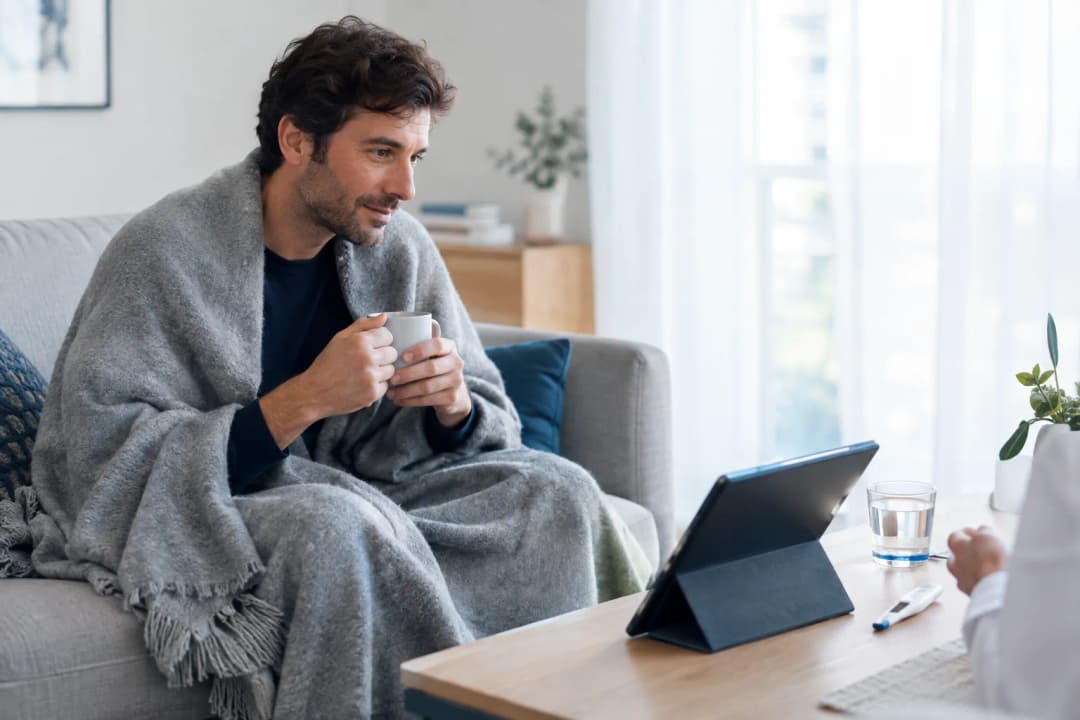
Shingles concerns in Spain: video consultation or local care?

Medically Reviewed by Dr. Pedro Yelamo Vera, MD
Licensed Physician No. 484814280 · Official Medical College of Bizkaia (Spain)Last reviewed: 11 October 2026
Shingles concerns in Spain: choose video or local care based on urgency, know the warning signs and when to seek prompt in-person assessment.
You don't have to figure this out alone
Dr. Pedro Yelamo Vera is an independent, bilingual GP licensed in Spain. Book a 20-minute video consultation in English or Spanish for €50, with a private electronic prescription issued under Spanish law when clinically appropriate.
If you're worried about shingles while in Spain, a video GP consultation can help assess your concerns, but a rash near your eye or nose, changes to your vision, or significant illness needs prompt local assessment. You do not need to identify the rash yourself before asking for help. Choose care according to your symptoms and how quickly you can be assessed—not simply which appointment is easiest to arrange.
- For shingles GP consultation Spain decisions, eye symptoms and serious illness take priority over appointment convenience.
- Dr. Pedro Yelamo Vera offers bilingual video GP consultations for patients currently in Spain; in-person assessment remains necessary when indicated.
- NHS guidance recommends prompt assessment for suspected shingles; treatment decisions depend on clinical evaluation.
- Call 112 or attend the nearest emergency department for a medical emergency; do not wait for video care.
Why this matters when you're away from home
A painful or unfamiliar rash can interrupt your holiday, work, or daily routine. Finding care in another language adds another concern: explaining what has changed and understanding what to do next.
You can ask for help without knowing whether the problem is shingles. Describe what you have noticed, where it is, and when it began; the clinician decides what assessment is needed.
For patients currently in Spain, Dr. Pedro Yelamo Vera provides English/Spanish video GP consultations. This guide explains the choice between that assessment and local care, rather than offering a diagnosis from a symptom checklist.
For a medical emergency, call 112 or attend the nearest local emergency department. The practice does not handle medical emergencies.
Shingles concerns in Spain: video consultation or local care?
Use video care for an initial discussion when there are no urgent warning signs and the appointment will not delay necessary assessment. Choose local care when your symptoms require a physical examination or urgent treatment decisions. A camera cannot replace every part of an examination.
The following comparison describes care routes, not diagnostic categories. If you are unsure which route fits your situation, contact a local healthcare service for triage rather than waiting for an online appointment.
| Care route | Best for | What it offers | Main limitation |
|---|---|---|---|
| Video GP consultation | Patients without urgent warning signs who need an initial assessment in English or Spanish | Discussion of symptoms, medical history, visible changes, and next steps | The doctor cannot perform a hands-on examination and can direct you to local care |
| Local GP or urgent care | Patients needing prompt examination, including concerns involving the eye or nose | In-person assessment and a decision about further care | You need to travel and explain your symptoms locally |
| Emergency department or 112 | Medical emergencies or life-threatening symptoms | Emergency assessment and treatment | It is not the route for routine administrative questions or planned follow-up |
NHS shingles guidance advises urgent assessment for a rash on the eye or nose, changes to vision, pregnancy, or a severely weakened immune system. These circumstances should not wait for a routine video slot. [Scientific citation: NHS — Shingles patient guidance.]
This decision framework applies to patients physically in Spain. It does not imply that the practice provides clinical consultations throughout Europe.
Video consultation: an initial assessment, not a confirmed diagnosis
A video consultation gives you time to explain your concerns in a language you understand. The doctor can ask about the onset, location, pain, visible skin changes, current medicines, and relevant medical history.
Dr. Pedro Yelamo Vera's bilingual video GP consultation is best for patients in Spain who need an initial assessment without urgent warning signs. Its practical benefit is access from your hotel or home; its limitation is that some concerns require a local physical examination.
You do not need to present a convincing case for shingles. Describe the symptoms honestly, including anything that does not fit your own suspicion, and let the doctor assess the possibilities.
A useful consultation ends with a clear next step. That can include advice, a request for local examination, or follow-up; it does not necessarily end with a prescription.
What video cannot establish on its own
Lighting, camera quality, and the location of a rash affect what the doctor can see. A photograph also cannot show every aspect of your condition or replace an examination where one is necessary.
Tell the doctor if the rash is difficult to show or if the pain seems more concerning than the visible changes. Do not treat a clear photograph as proof that remote care is sufficient.
The clinician decides whether the information available supports a safe assessment. If local care is recommended, that is the next step—not a failure of the consultation.
Local care: when examination takes priority
Seek prompt local medical assessment if the rash involves your eye or nose, your vision changes, you are pregnant, or you have a severely weakened immune system. Mention these circumstances when you first contact the service, rather than leaving them until the end of the conversation. [Scientific citation: NHS — Shingles patient guidance.]
For a medical emergency, call 112 or go to the nearest local emergency department. Do not wait for a response from an online clinic if you have life-threatening symptoms, such as severe difficulty breathing or loss of consciousness.
If language is the main obstacle, prepare a short written description in English and Spanish. Include the start date, the affected area, and any urgent concern; a hotel reception team or trusted companion can help you communicate where to seek care without making clinical decisions for you.
The essential distinction remains the same: appointment convenience does not override the need for urgent assessment. An online message or booking confirmation is not clinical triage.
Why the right care route varies
The choice depends on your symptoms and circumstances, not whether you are a tourist, an expat, or a resident. These factors help the clinician decide what comes next:
- Location: Skin changes near the eye or nose require prompt assessment rather than routine remote follow-up.
- Timing: Tell the clinician when pain and skin changes began, because timing matters to treatment decisions.
- Relevant medical history: Pregnancy and a severely weakened immune system change the urgency of assessment.
- Need for examination: A video view is not enough when the clinician needs to examine you directly.
- Access to timely care: Do not wait for a preferred online appointment if local assessment is needed sooner.
[Scientific citation: NHS — Shingles patient guidance; NICE Clinical Knowledge Summaries — Shingles management guidance.]
You are not expected to weigh these factors clinically yourself. Your task is to report them clearly and follow the assessment route recommended by a healthcare professional.
How should you prepare for a video GP assessment?
Preparation helps you explain your concerns without rushing. It should never delay urgent care or become a reason to wait until you have perfect photographs or complete records.
Use this sequence if a video consultation is appropriate:
- Check urgency. Decide whether you need local triage first, particularly if there are eye symptoms or other urgent concerns. Call 112 for a medical emergency.
- Record onset. Write down when the discomfort started and when you first noticed visible skin changes. Keep those dates separate if they differ.
- Gather records. Have your medicine list, allergies, relevant medical history, and any recent clinical notes available. Mention pregnancy or medicines that affect your immune system.
- Prepare images. If the practice requests photographs, use the secure process it provides. Tell the doctor if you cannot obtain a clear image.
- Confirm next steps. Before the consultation ends, ask whether you need local examination, what follow-up is appropriate, and what should prompt urgent help.
You can also read the practice's guide to preparing for an online GP consultation. For a rash concern, the most useful preparation is an accurate account of what changed and when.
Explain the impact, not just the appearance
Tell the doctor how the discomfort affects sleep, movement, or normal activities. Mention whether symptoms are changing and whether another clinician has already assessed you.
Avoid describing the problem only as shingles. Saying that you are concerned about shingles while explaining what you actually notice gives the clinician more useful information.
How soon should I ask for an assessment?
Ask for prompt medical assessment rather than waiting for the rash to become easier to recognise. NHS guidance explains that antiviral treatment, when indicated, generally needs to start within 3 days of the rash appearing; NICE guidance discusses the initial 72 hours and circumstances where later treatment is considered. [Scientific citation: NHS — Shingles patient guidance; NICE Clinical Knowledge Summaries — Shingles management guidance.]
Those timings are not instructions to self-treat, and they do not guarantee that treatment is appropriate. They explain why the date of onset matters and why waiting for a convenient appointment can be the wrong choice.
If more than 72 hours have passed, still seek medical advice. Do not assume you have missed every opportunity for assessment or that ongoing symptoms no longer need attention.
Can a video consultation lead to a prescription?
A prescription is not the automatic result of a video consultation. Where clinically appropriate, following a genuine evaluation. The doctor assesses whether prescribing is suitable and whether remote assessment provides enough information.
Treatment and prescriptions are issued solely at the doctor's discretion based on evidence-based clinical guidelines. The practice provides private electronic prescriptions under Spanish law, but neither the medicine nor the issuing of a prescription is guaranteed.
A previous prescription does not settle the current decision. Bring the details if you have them, but expect the clinician to assess your present symptoms and circumstances.
For patients in Spain, the practical goal is an appropriate care plan. That can require local examination before any treatment decision.
What should I ask before the consultation ends?
Ask the doctor to explain the next action in plain language. If you are anxious or unfamiliar with the local system, it is reasonable to request a brief summary.
Useful questions include:
- Do I need an in-person examination, and how urgently?
- What information should I give the local clinician?
- What changes mean I should seek urgent help?
- Is follow-up needed, and who should provide it?
- If documentation is appropriate, what can it accurately record?
Do not assume a video appointment completes the whole episode of care. A local examination or follow-up can be an essential part of the plan.
What the practice offers—and what it does not
Dr. Pedro Yelamo Vera is a GP licensed in Spain (Colegiado No. 484814280), providing bilingual English/Spanish consultations for patients in Spain. The practice offers unhurried video consultations and a GDPR-conscious approach to patient information.
That is not an emergency response promise, a guaranteed appointment time, or a reason to delay urgent local assessment.
The service can reduce language and travel friction when remote assessment is suitable. It does not replace an emergency department, guarantee a diagnosis over video, or guarantee a prescription or certificate.
Share sensitive information through the process the practice provides. If you are unsure where to send photographs or records, ask before sending them.
FAQ
Can I discuss possible shingles with an online GP in Spain?
Yes, a video GP consultation can provide an initial assessment when there are no urgent warning signs and it will not delay necessary care. The doctor decides whether you also need local examination.
Should I book a video consultation if the rash is near my eye?
A rash on the eye or nose, or changes to vision, needs prompt local medical assessment. Do not wait for a routine video appointment; NHS shingles guidance identifies these as reasons for urgent advice.
Do I need to know whether the rash is shingles before booking?
No, you do not need to identify the rash yourself before seeking care. Explain what you have noticed, where it is, and when it began so the clinician can assess your concerns.
What if the rash started more than three days ago?
More than 3 days since rash onset does not mean you should stop seeking advice. A clinician must assess your current symptoms and decide whether treatment or local examination is needed.
Will an online shingles consultation guarantee a prescription?
No, a video consultation does not guarantee a prescription. Where clinically appropriate, following a genuine evaluation. Treatment and prescriptions are issued solely at the doctor's discretion based on evidence-based clinical guidelines.
Can I have the consultation in English while staying in Spain?
Yes, Dr. Pedro Yelamo Vera provides bilingual English/Spanish video GP consultations for patients currently in Spain. Remote care remains subject to clinical suitability and does not replace necessary local assessment.
What should I do if this becomes a medical emergency?
Call 112 or attend the nearest local emergency department for a medical emergency. The practice does not handle medical emergencies, so do not wait for an online reply or scheduled consultation.
One last thing
Write down when the discomfort began and when the rash appeared as separate events. That small distinction gives the clinician a clearer account than simply saying the problem started recently.
When arranging care in Spain, prioritise the right assessment over the most convenient format. Video care is useful when suitable; local care is necessary when the symptoms or examination requirements demand it.
Related guides
Medical Citations & Sources
This content is written and reviewed by a licensed physician with reference to the following official health authorities.