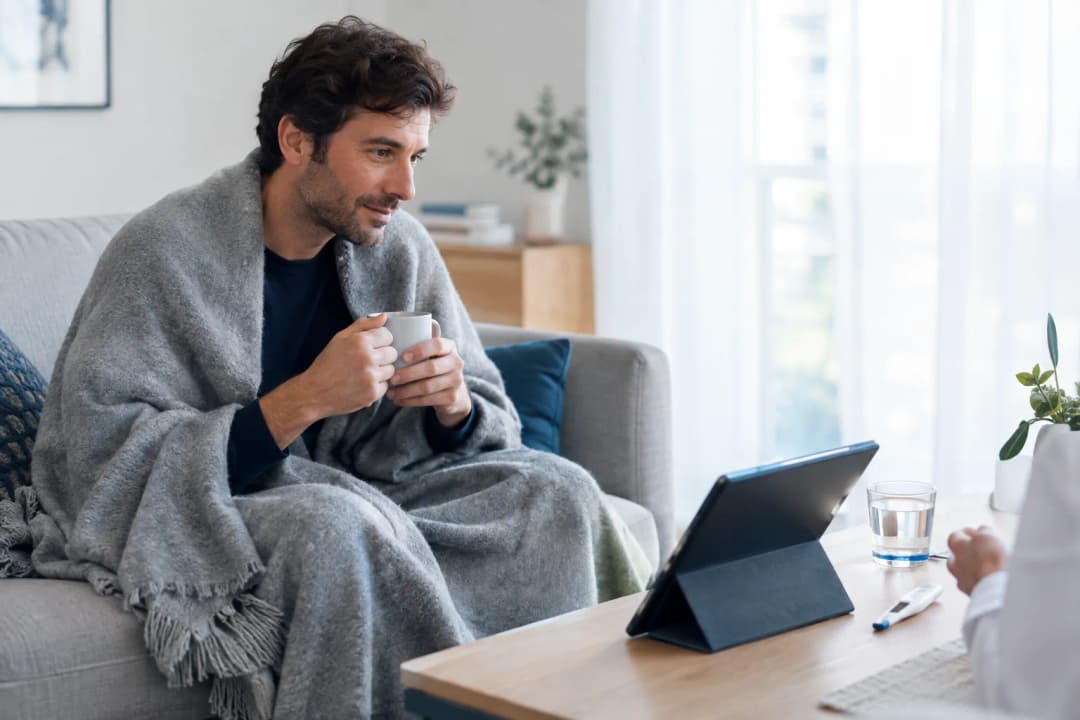
Online GP for diplomats in Spain: confidential video care

Medically Reviewed by Dr. Pedro Yelamo Vera, MD
Licensed Physician No. 484814280 · Official Medical College of Bizkaia (Spain)Last reviewed: 11 October 2026
Confidential video GP care for diplomats in Spain: how to prepare, its limits, and keeping medical needs separate from mission paperwork.
You don't have to figure this out alone
Dr. Pedro Yelamo Vera is an independent, bilingual GP licensed in Spain. Book a 20-minute video consultation in English or Spanish for €50, with a private electronic prescription issued under Spanish law when clinically appropriate.
Diplomats in Spain seeking confidential online GP care can find it difficult to discuss personal health concerns around official schedules, shared offices and unfamiliar healthcare arrangements. You can explain your concerns in English or Spanish; this guide shows how to prepare for a private video consultation, keep administrative requests separate from clinical care and recognise when you need an in-person service.
- For the search ‘online doctor diplomats spain’, prioritise confidential clinical assessment over promises of paperwork or prescriptions.
- Dr. Pedro Yelamo Vera offers bilingual video consultations for patients currently in Spain; emergencies require local emergency care.
- Check who receives medical documents before sharing them with a mission, employer or insurer.
- A video consultation does not replace required occupational or other in-person fitness examinations.
Why confidential GP care matters for diplomats in Spain
Your medical concern and your employer’s administrative needs are different matters. A request for an absence document, insurance evidence or a fitness assessment should not determine the clinical decision made during your appointment.
You do not need to turn a medical conversation into a briefing about your work. Start with the health concern, then explain any relevant schedule, travel or document requirement. That gives the doctor useful context without adding unrelated professional information.
Dr. Pedro Yelamo Vera’s online GP consultations are best suited to English- or Spanish-speaking patients in Spain seeking non-emergency medical guidance. The practice offers secure video consultations and GDPR-compliant telemedicine. He is a GP licensed in Spain (Colegiado No. 484814280).
You can review the practice through Dr. Pedro Yelamo Vera before deciding whether video care fits your needs. Diplomatic status does not remove the need for a genuine medical evaluation or change the limits of a remote appointment.
For your posting, establish a practical care arrangement before an administrative deadline becomes urgent. Keep the route to video care separate from the route to local examinations, testing and emergency services.
Medical emergencies: call 112 or go to the nearest local emergency department. This practice does not handle medical emergencies. Do not wait for an online appointment or a message response when emergency help is needed.
Prepare confidential video care around your posting
The simplest preparation starts with your own notes and existing records. You do not need a paid organisation tool or an embassy-specific health platform to describe your concern clearly.
Use the following steps to decide whether video care is appropriate, arrange a private setting and explain any paperwork request without assuming the doctor can fulfil it.
Check whether your request fits video care
Write down what you want help with before choosing an appointment format. Distinguish a medical discussion from a request that requires a physical examination or a designated examiner.
A video GP appointment can provide a discussion of your symptoms, medical history, existing treatment or laboratory reports. The doctor decides whether remote assessment is sufficient and whether local care is needed. Having a document deadline does not make an otherwise unsuitable remote assessment appropriate.
If a mission or employer asks for a fitness certificate, obtain the actual requirements first. A general consultation is not a substitute for required occupational, aviation, maritime, driving or sporting examinations. Check whether the requesting organisation specifies a particular examiner or assessment process.
- State the main reason for the appointment in plain language.
- Separate your health concern from any certificate request.
- Bring the requesting organisation’s examination requirements.
- Use 112 or the nearest emergency department for medical emergencies.
Set up a private consultation space
Start with a room where you can speak without being overheard. A closed door, headphones and a device you control are more useful than trying to discuss sensitive details between meetings.
Privacy also depends on your surroundings. A secure consultation service cannot stop someone entering your office, viewing your screen or hearing your side of the conversation. Choose a setting where you can give the doctor your attention and answer personal questions comfortably.
For your consultation arrangements, check whether a work device or shared account is appropriate for personal healthcare. Follow applicable workplace rules, but avoid forwarding clinical information through office channels simply because those channels are convenient.
- Choose a room where interruptions are unlikely.
- Use headphones when other people are nearby.
- Close unrelated documents and notifications.
- Check who can access the device and email account you use.
Assemble a focused medical summary
Begin with a short note covering your concern, when it started and what you want to understand. Add your current medicines, known allergies and relevant previous assessments without trying to interpret the findings yourself.
If you have records from another country, keep the original documents. Note their language and identify the reports most relevant to the appointment. Ask how to submit them securely rather than placing sensitive attachments into an unconfirmed channel.
Dr. Pedro Yelamo Vera provides bilingual online GP care in English and Spanish, including chronic-condition follow-up and laboratory-result reviews. A prepared summary helps keep the consultation focused on your clinical questions rather than reconstructing scattered information.
Use the online GP consultation preparation guide to organise the essentials. Your aim is an accurate account, not a polished dossier.
- Write a brief timeline of the concern.
- List current medicines and known allergies accurately.
- Select relevant reports and retain their original wording.
- Note previous advice and any unresolved questions.
Clarify the document recipient and purpose
Before requesting paperwork, ask the receiving organisation what it actually needs. An insurer, a mission’s administrative team and an occupational-health service can have different requirements. Do not assume that a general medical letter serves every purpose.
Obtain the form or written instructions yourself. Check the intended recipient, required information, submission method and deadline. Then show those requirements to the doctor, who can explain whether the request falls within the consultation’s scope.
For paperwork requested, confirm the current rules directly with the recipient. A previous colleague’s experience does not establish that your document will be accepted. The clinic cannot guarantee a certificate or the receiving organisation’s decision.
Where clinically appropriate, following a genuine evaluation. This condition applies to any prescription or medical certificate under consideration.
- Obtain the exact form or written requirements.
- Identify who will receive the document.
- Ask whether an in-person examination is required.
- Confirm the submission route and acceptance criteria with the recipient.
Explain your concern and agree the next step
Open the appointment with your main concern rather than the administrative outcome you hope to obtain. Explain what has changed, what you have already done and what questions remain. Tell the doctor if language barriers or previous fragmented care have made the situation difficult.
You can then discuss the practical constraints around your posting. Mention travel plans or work commitments when they affect follow-up, but do not let those constraints replace the medical assessment. Ask for clarification whenever the proposed next step is unclear.
Dr. Pedro Yelamo Vera offers unhurried consultations, allowing you to discuss your concerns in English or Spanish. That service remains a clinical encounter, not a guaranteed route to treatment or paperwork.
Treatment and prescriptions are issued solely at the doctor's discretion based on evidence-based clinical guidelines. private electronic prescriptions under Spanish law are provided only where clinically appropriate, following a genuine evaluation.
- Describe the health concern before discussing paperwork.
- Explain relevant previous care and outstanding questions.
- Ask whether examination or testing is needed locally.
- Confirm the agreed next step before ending the call.
Keep follow-up separate from workplace administration
After the consultation, keep the clinical plan in your personal health records. Record what you need to arrange and which questions remain open. If an in-person appointment is recommended, organise that next step rather than treating the video call as the end of care.
Manage any workplace document as a separate task. Check its recipient and contents before sending it. Do not forward an entire consultation record when you have only been asked for a specific document; clarify the requirement instead.
During your posting, maintain a record you can understand and retrieve when needed. If you later move or consult another clinician, ask what information is appropriate to share and how to transfer it securely.
- Save the agreed clinical next steps securely.
- Arrange recommended local appointments or tests.
- Check each document’s recipient before sending it.
- Keep personal medical records separate from routine office correspondence.
The process is straightforward: establish the care need, protect the conversation, prepare accurate information and confirm follow-up. Administrative requests belong alongside that process, not in control of it.
Compare care options for your situation
Choose the care setting by the assessment you need, not by diplomatic status. Video care supports a private conversation without travelling to the clinic; local services provide the examinations and urgent care that a remote consultation cannot deliver.
These options serve different purposes. You can use private video care alongside local healthcare rather than treating either route as a complete replacement for the other.
| Option | Best for | Main advantage | Key limitation |
|---|---|---|---|
| Dr. Pedro Yelamo Vera video consultation | Patients in Spain seeking bilingual, non-emergency GP guidance | English/Spanish consultation from a private location | Cannot provide a hands-on examination or guarantee prescriptions or certificates |
| Local in-person GP appointment | Concerns requiring physical examination | Allows direct examination | Requires travel and coordination with the local service |
| Designated occupational or fitness examiner | Formal assessments requiring a specified examination process | Matches the requesting authority’s assessment route | A general video GP visit does not replace this examination |
| Local emergency department or 112 | Medical emergencies | Provides the emergency-care route | Not a substitute for planned routine follow-up |
If video care fits the concern, you can explore the consultation process without committing to a particular clinical outcome.
Check whether video care fits
Review bilingual GP consultation information for non-emergency care while you are in Spain.
Common mistakes diplomats make when arranging care
Treating a document deadline as a clinical instruction
A deadline explains your circumstances; it does not establish that a certificate can be issued. Bring the recipient’s requirements and allow the doctor to determine what can be supported after assessment.
Keep the requested document separate from the medical decision. Where clinically appropriate, following a genuine evaluation.
Assuming confidential care means no medical record
Do not equate privacy with an undocumented consultation. Ask how your information is handled and how any requested documents will be delivered. Avoid sending unnecessary professional material with your medical history.
You can explain a work constraint without disclosing confidential mission business. Share information relevant to care, not a full account of your role.
Letting an intermediary manage every detail
An assistant or colleague can help with scheduling, but that does not mean they need access to your clinical discussion. Decide what administrative help you want and which communications should reach you directly.
Check the email address used for appointment messages. A shared inbox can create a privacy problem even when the consultation itself is secure.
Treating video care as formal fitness clearance
A helpful medical conversation is not automatically an occupational or other regulated assessment. Read the requesting authority’s instructions before booking and identify any designated examiner requirement.
Do not assume that a video GP consultation replaces a required in-person fitness examination. Confirm the correct route before relying on a document for an official decision.
FAQ
Can diplomats currently in Spain consult a GP online in English?
Yes. Dr. Pedro Yelamo Vera provides English/Spanish video GP consultations for patients currently in Spain. The doctor assesses whether the concern is suitable for remote care.
Is an online GP consultation confidential if I use an embassy office?
Your surroundings still affect privacy, even when the consultation service is secure. Choose a room where you cannot be overheard and check who can access your device and appointment messages.
Do I need to share confidential details about my diplomatic work?
Explain information relevant to your health and follow-up, rather than unrelated mission business. Tell the doctor about practical constraints without attaching unnecessary professional documents.
Will the doctor issue a prescription after the video call?
A prescription is not guaranteed. Where clinically appropriate, following a genuine evaluation. Treatment and prescriptions are issued solely at the doctor's discretion based on evidence-based clinical guidelines.
Can I obtain a certificate that my mission will accept?
Neither certificate issuance nor acceptance is guaranteed. Bring the mission’s written requirements; any certificate is considered where clinically appropriate, following a genuine evaluation, and the receiving organisation determines acceptance.
Can a video GP complete my required occupational fitness examination?
A video GP consultation does not replace a required in-person occupational or other fitness examination. Check whether the requesting authority specifies an examination process or designated examiner.
What should I do if I need emergency medical help in Spain?
Call 112 or go to the nearest local emergency department. The practice does not handle medical emergencies, so do not wait for an online appointment or message response.
One last thing
Ask who needs the document before asking what it should say. That question helps you distinguish an administrative request from a clinical assessment and avoid sharing more information than the recipient has requested.
For your care arrangements, keep a private list of your preferred consultation route, local in-person services and emergency contact number. A clear plan leaves less to organise when you are already uncomfortable or worried.
Related guides
Medical Citations & Sources
This content is written and reviewed by a licensed physician with reference to the following official health authorities.