Online doctor consultations for short-term EU visitors
Online doctor short term EU visitor guide: see when a bilingual GP video call fits, what to prepare, and why prescriptions need assessment first in 2026.

Written & Medically Reviewed by Dr. Pedro Yelamo Vera, MD
Licensed physicianLast Updated: 23 September 2026
Short-term EU visitor online care is a private GP video consultation aimed at getting non-emergency medical guidance while you are away from your usual doctor. A short stay, an unfamiliar health system, or a language barrier can make it hard to know whom to ask. In 2026, you can start with a confidential assessment in English or Spanish and leave with clearer next steps, even if an in-person visit turns out to be necessary.
- An online doctor for a short-term EU visitor is best for non-emergency guidance, not urgent care.
- Dr. Pedro Yelamo offers bilingual GP video consultations for visitors in Spain and people seeking a Spanish clinician from elsewhere in the EEA.
- A video assessment can address symptoms, ongoing conditions, lab results, and certificate requests; outcomes are not guaranteed.
- If you have a medical emergency, call 112 or go to the nearest emergency department.
Why online GP care matters during a short stay
A visitor has a different problem from someone settled in Spain. You may need an answer before your next journey, but you may not know which local service to contact or how to explain your concern in Spanish. If your question involves an existing condition, you also need room to explain what has happened before this trip.
You do not have to solve every part of that process at once. Start by deciding whether the concern needs emergency or in-person care. For a non-emergency question, a GP video consultation gives you a place to explain the issue and discuss what to do next. The same planning problem affects people who travel regularly; this guide to online consultations for digital nomads in the EU covers that situation in more detail.
Dr. Pedro Yelamo GP video consultations are best for short-term visitors who want a bilingual, non-emergency assessment, not a promised prescription or certificate. He is a licensed general practitioner in Bilbao who consults in English and Spanish. The stated response time is under 24 hours; that is a response time, not a promise of an appointment within 24 hours.
In 2026, the key distinction remains simple: a video call provides an individual assessment, while emergency care and any examination that must happen in person require another route. For a medical emergency, call 112 or go to the nearest local emergency department. Do not wait for a video consultation.
How to arrange care without losing track of your trip
Follow these steps in order. The early work is yours to do: check urgency, read your own coverage terms, and gather what you already know. A clinician then assesses the concern and explains the available next steps. None of the preparation guarantees that remote care will be suitable.
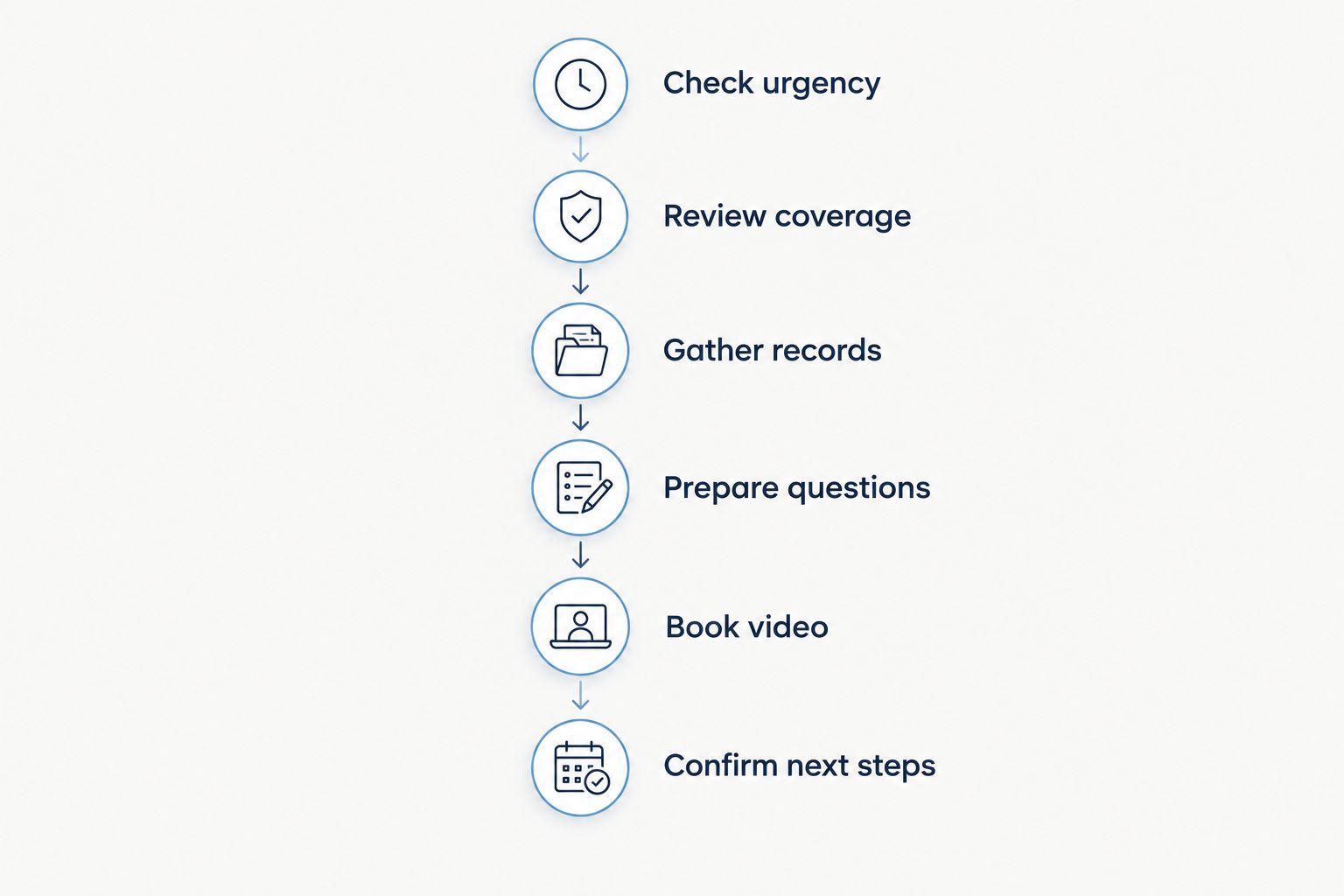
Check urgency
Decide whether it is safe to spend time arranging a routine appointment. You cannot use a booking form to assess an emergency, and an online GP cannot replace emergency services. If you are unsure how serious a rapidly changing problem is, seek immediate local medical help rather than waiting for a reply.
- Call 112 or go to the nearest local emergency department for a medical emergency.
- Choose an in-person service when you already know you need a physical examination or procedure.
- Use a video consultation for a non-emergency question that needs an individual assessment.
- Tell the clinician if your circumstances change before the appointment so the next step can be reconsidered.
Review coverage
Check the documents you already have before assuming a private consultation will be reimbursed. Your insurance policy, travel documents, and any instructions from your insurer are the starting point. A doctor's assessment and an insurer's payment decision are separate matters.
- Look for the policy terms that apply to private and remote consultations.
- Ask your insurer whether it requires you to contact it before receiving care.
- Check what documentation the insurer asks you to keep for a claim.
- Do not treat a medical certificate as a promise of reimbursement or acceptance.
In 2026, a short visit does not change what your particular policy says. If a term is unclear, ask the insurer directly; the GP cannot approve a claim on its behalf.
Gather records
You can make the consultation more focused without assembling a complete medical file. Bring the information you have, and say plainly what you do not know. That matters if the question concerns an ongoing condition, a previous recommendation, or a medicine you are already taking.
- Write down your main concern and when it began.
- List the medicines you currently take, using the names on their packaging where possible.
- Note relevant existing conditions and any information you have been told is important to your care.
- Keep recent results or documents ready if you want them reviewed.
- Say which country you are in during the call and when you expect to leave.
Do not delay asking for help solely because a document is unavailable. The clinician can tell you whether the missing information limits what can be assessed remotely.
Prepare questions
A short list keeps your priorities clear when you are speaking from a hotel, temporary home, or unfamiliar city. You do not need to arrive with a diagnosis. Describe the concern in your own words and ask what decision the consultation can help you make.
- Put the most pressing non-emergency question first.
- Ask whether a physical examination is needed to assess the concern.
- Explain if you need advice about an existing condition while away from home.
- If you need a document, identify who will receive it and what they have requested.
The purpose is not to persuade a doctor to issue a particular document or medicine. It is to give the doctor enough context to assess your situation and explain any limits.
Book video
When a video assessment fits the concern, choose a clinician whose language and scope of care fit your needs. Dr. Pedro Yelamo provides confidential English- and Spanish-language private GP video consultations. The stated experience includes 2,221 online consultations and a 5.0 rating from more than 30 Google and Doctoralia reviews; neither figure predicts your clinical outcome.
- Check the available times against your travel plans rather than assuming an immediate appointment.
- Choose the language in which you can explain your concern most clearly.
- Find a private place where you can speak without being overheard.
- Keep the records and questions you prepared within reach.
- Ask in advance if you are uncertain whether video is appropriate for your concern.
A response time under 24 hours is useful when planning a short stay, but it does not establish when an appointment will take place. If the matter becomes urgent, use local urgent or emergency care instead of waiting.
Confirm next steps
Before the call ends, make sure you understand what the assessment did and did not resolve. Ask whether you need in-person care, further evaluation, or follow-up. If you are leaving Spain or another EEA country soon, tell the clinician so that the advice takes your travel plans into account.
- Repeat back the next step if any part of the explanation is unclear.
- Ask whether follow-up can happen remotely or needs an in-person clinician.
- Clarify what, if any, documentation results from the assessment.
- If a Spanish prescription is considered, ask about the practical limits on dispensing where you are.
Treatment and prescriptions are issued solely at the doctor's discretion based on clinical Evidence-Based Medicine (EBM) guidelines. Where clinically appropriate, a Spanish prescription may be issued for a patient across the EEA. Pharmacy decisions, medicine availability, and applicable local restrictions still determine whether it can be dispensed. A consultation does not guarantee a prescription, treatment, certificate, or particular outcome.
Which care option fits your situation?
In 2026, choose the route by what needs to happen, not by which option appears simplest to book. A video call offers a conversation and assessment; it cannot perform an examination that requires you to be physically present. The options below have different strengths and limits.
| Option | Best for | Main advantage | Key limitation |
|---|---|---|---|
| Emergency services or local emergency department | A medical emergency | Direct access to emergency assessment | Not a substitute for planning routine follow-up |
| Local in-person clinician | A concern requiring physical examination | Can assess you in person | Language and appointment arrangements depend on the provider |
| Insurer-directed service | Visitors whose policy specifies a care route | Lets you follow your own policy's instructions | The insurer's terms determine what it will cover |
| Dr. Pedro Yelamo GP video consultation | Non-emergency bilingual assessment or follow-up | English- or Spanish-language access to a licensed GP | Remote care may not be suitable; no document or prescription is guaranteed |
For a short-term visitor with a non-emergency concern, a bilingual GP video consultation is a sensible first assessment when an in-person examination is not already needed. For an emergency, choose emergency care. If your insurer requires a particular service, check that requirement before you book private care.
Check whether video care fits
Discuss a non-emergency concern in English or Spanish and see available times.
Common mistakes short-term visitors make
Treating a video booking as an emergency plan
An online appointment is not a place to wait while an emergency develops. Save the local emergency number before you need it. In Spain and elsewhere in the EU, call 112 for a medical emergency or go to the nearest local emergency department.
Assuming every request produces a document
A certificate request starts with an assessment, not a form to be signed. Explain why you need the document and who will receive it. The doctor decides whether a certificate is clinically appropriate; the receiving organisation decides whether to accept it.
Leaving out the travel details
Your current country and departure plans affect the practical next steps you need to discuss. Tell the GP where you are and whether you can attend in-person care if advised to do so. This is especially relevant when your stay ends soon.
Assuming a Spanish prescription will be dispensed anywhere
A decision to prescribe is separate from a pharmacy's decision to dispense. Do not plan a journey around an expected prescription. Discuss clinical suitability first, then check local pharmacy requirements and medicine availability if a prescription is issued.
Confusing response time with appointment availability
The stated response time is under 24 hours. It is not a guaranteed consultation time or a reason to put off urgent care. Check available times and choose another care route if your need cannot wait.
FAQ
Can a short-term visitor in Spain use an online doctor in 2026?
Yes, a short-term visitor can seek a private GP video consultation for a non-emergency concern in 2026. The doctor assesses whether remote care is suitable for that individual situation.
What can I discuss with an online GP during a short EU stay?
You can raise a non-emergency health concern, ask about chronic-condition follow-up, or request a review of available lab results. The consultation is an assessment and does not guarantee a diagnosis or treatment.
Can an online GP issue a medical certificate for a visitor?
A GP can consider a medical certificate after a genuine clinical evaluation. Issuing it is not guaranteed, and the organisation receiving it decides whether to accept it.
Can a visitor get a Spanish prescription after a video consultation?
A Spanish prescription may be issued where the doctor judges it clinically appropriate. Dispensing across the EEA remains subject to the pharmacy, medicine availability, and applicable local restrictions.
What if I need an examination rather than a video call?
Seek an in-person clinician when a physical examination is needed. A video GP can also explain when remote assessment is insufficient for the concern you describe.
Does travel insurance pay for a private online consultation?
Your own policy determines whether a private online consultation is reimbursed. Check its terms and any insurer instructions before booking; reimbursement is not guaranteed.
What should I do in a medical emergency while visiting the EU?
Call 112 or go to the nearest local emergency department. Do not wait for a reply or an online GP appointment when you need emergency help.
One last thing
Before asking for a certificate or prescription, decide what you actually need help understanding. That changes the conversation from a request for a predetermined result into a clinical assessment with clear limits. In 2026, that is the safer way to use online care during a short trip: bring your information, explain your plans, and leave knowing what the doctor recommends next.
Related guides
- How to prepare for an online GP consultation
- How to get a prescription online as an expat in the EU
- Online doctor consultations for cruise ship passengers in port
Medically Reviewed by Dr. Pedro Yelamo Vera, EU-Licensed GP
Medical Citations & Sources
This content is written and reviewed by a licensed physician with reference to the following official health authorities.