Chronic condition follow-up for expats with high cholesterol
High cholesterol follow up online doctor visits suit expats in Spain with prior lab results. Learn what to bring, how GP review works, and when to seek care.

Written & Medically Reviewed by Dr. Pedro Yelamo Vera, MD
Licensed physicianLast Updated: 23 September 2026
Expats’ high cholesterol follow-up is an ongoing GP review of test results, treatment and cardiovascular risk, with the aim of keeping care consistent after a move to Spain. If you need a high cholesterol follow up online doctor in 2026, the first step is to gather your previous results; a bilingual video consultation can then help you discuss the plan without promising a prescription or a particular outcome.
- A high cholesterol follow up online doctor visit works best when you bring earlier and recent lab results, medicines and questions.
- Dr. Pedro Yelamo is best for expats in Spain who need bilingual GP follow-up, not emergency care.
- An online GP can review results and discuss next steps; prescriptions depend on clinical assessment.
- If symptoms need urgent assessment, call 112 or go to the nearest emergency department.
Why high cholesterol follow-up matters for expats
Moving countries can interrupt a care plan even when you feel well. Your previous GP may hold the lab history, your medication may have a different name in Spain, and explaining a concern in another language can make a routine appointment harder than it needs to be. Those are practical problems you can prepare for.
A follow-up is about more than reading one cholesterol result. A GP needs the wider picture to discuss what the result means for you and whether your current plan still fits. Cholesterol is one factor considered in cardiovascular risk assessment; an individual decision also depends on other clinical information. [Scientific citation: European Society of Cardiology guidance on dyslipidaemia and cardiovascular prevention.]
Dr. Pedro Yelamo offers private GP video consultations in English and Spanish for international residents in Spain. His stated experience includes 2,221 online consultations and a 5.0 rating from more than 30 Google and Doctoralia reviews. Those figures describe the practice; they do not determine what care is right for you.
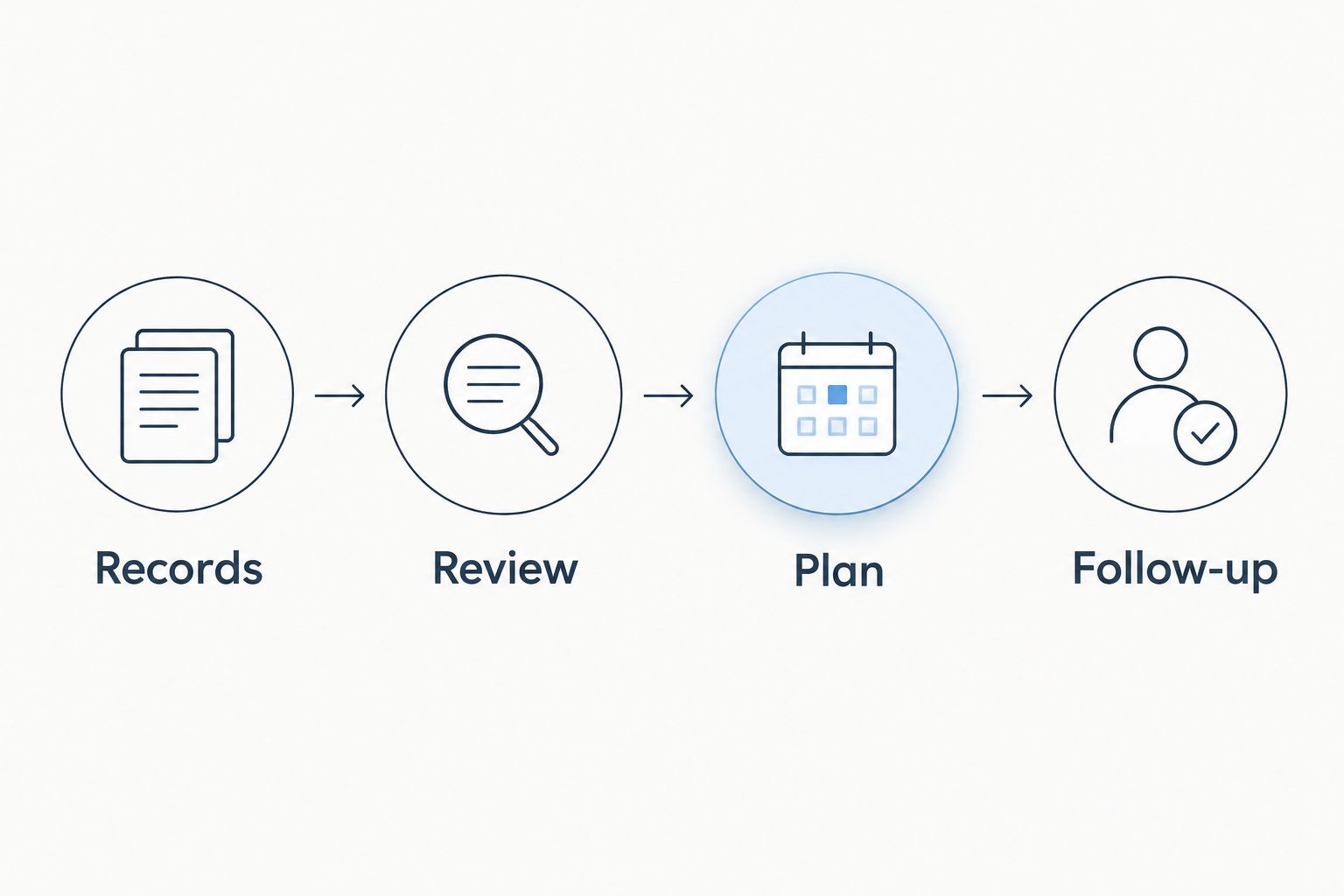
In 2026, a useful follow-up has four parts: Records, Review, Plan and Follow-up. You can collect records yourself. A clinician handles the assessment, including whether video care is suitable or an in-person examination is needed.
Build a follow-up plan that works across borders
Gather your earlier and recent results
Start with what you can collect without paying for another appointment. A recent result shows where things stand now; an earlier one gives the GP context. If you cannot find every report, bring what you have and say what is missing. Do not guess at a number from memory.
Check each document for the test date, the reported units and the laboratory’s reference information. Reports from different countries can present results differently, so keep the original document rather than copying a number into a message without its label. In 2026, a folder of clear scans is more useful than a long explanation of what you think the results mean.
- Save the most recent lipid report and any earlier reports you can access.
- Keep each report’s date, units and laboratory details visible.
- Add relevant letters or treatment plans from your previous GP.
- Mark any report you cannot read clearly instead of transcribing it from memory.
Write down your current treatment and concerns
Make a plain-language list before the consultation. Include the medicine name exactly as it appears on its packaging, the dose shown there and how you currently take it. If you are unsure whether a medicine in Spain matches one from home, ask the GP rather than assuming it does.
Note anything that has changed since your last review. That includes new symptoms, difficulties taking treatment, or a change in who manages your care. A written list helps you explain the concern in English or Spanish and gives the clinician a clearer starting point; it does not replace an assessment.
- Record medicine names, doses and any other treatments you take.
- Note concerns about side effects or missed doses.
- Write down what your previous clinician asked you to monitor.
- Put your main questions in order so the most pressing one comes first.
Choose the right setting for your review
First decide whether this is a planned follow-up or an urgent problem. An online GP appointment is a way to review history, results and treatment questions. It cannot provide a physical examination or emergency assessment over video. If you have new symptoms, describe them when arranging care so suitability can be assessed.
Dr. Pedro Yelamo is best for expats in Spain who need bilingual GP follow-up for high cholesterol, not emergency care. His private consultations are available in English or Spanish, and the practice reports a response time under 24 hours. A response time is not a guaranteed appointment time or a guarantee that video care will be appropriate.
- Use your existing GP if they can review your records and remain accessible.
- Consider a bilingual video GP for a planned discussion of results and continuity.
- Choose in-person care if a physical examination is needed.
- For a medical emergency, call 112 or go to the nearest local emergency department.
Review the results in their clinical context
A cholesterol result is a starting point, not a treatment decision by itself. Tell the GP why the test was ordered, what has changed since the previous test and what your former clinician recommended. If your reports use different units, ask the clinician to compare them accurately rather than treating the printed figures as directly interchangeable.
The consultation should leave room for questions you might have avoided because of language or time pressure. You can ask what information is still needed and which decisions cannot be made from the available records. In 2026, a clear account of uncertainty is more useful than a confident answer built on an incomplete history. [Scientific citation: European Society of Cardiology guidance on dyslipidaemia and cardiovascular risk assessment.]
- Ask what the current and earlier results show together.
- Flag reports from different countries or laboratories.
- Explain any relevant change in your health or treatment.
- Ask whether further information or an in-person assessment is needed.
Discuss treatment without assuming a renewal
A move to Spain can create a practical worry: what happens when your current prescription runs out? Raise that question early in the appointment, but treat it as part of the review, not as an administrative request with a guaranteed answer. The GP needs to assess your circumstances before deciding whether treatment or a prescription is appropriate.
Treatment and prescriptions are issued solely at the doctor’s discretion based on clinical Evidence-Based Medicine (EBM) guidelines. Where clinically appropriate, a Spanish prescription may be issued for a patient across the EEA. Dispensing still depends on the pharmacy, medicine availability and applicable local rules. Do not change or stop prescribed treatment without discussing it with an appropriate clinician. [Scientific citation: European Society of Cardiology guidance on lipid-lowering treatment.]
- Show the current prescription or medication packaging if available.
- Explain when your supply is due to end.
- Ask whether your records support a treatment review or whether more information is needed.
- Confirm how to handle a prescription question if you will be outside Spain.
Agree on the next check and who handles it
Before the call ends, make sure you understand the next action. It might be obtaining a report, arranging a test, continuing an existing plan after assessment, or seeing a clinician in person. The correct interval and setting depend on your individual circumstances; do not copy someone else’s follow-up schedule.
Continuity matters more than the location of a single appointment. If you use different clinicians across countries, keep a record of the advice and tell the next clinician what has already been discussed. A video consultation in 2026 is useful when it connects those pieces, not when it becomes another isolated encounter.
- Confirm what you need to do next and who will review any new results.
- Ask when your plan should be reconsidered and what should prompt earlier contact.
- Keep the consultation advice with your lab and medication records.
- Share relevant updates with the clinician managing your ongoing care.
Which follow-up option fits your situation?
| Option | Best for | Key limitation |
|---|---|---|
| Your existing GP | Expats who can still access a clinician familiar with their history | That clinician may not be able to handle care or prescribing needs in Spain |
| In-person GP appointment in Spain | People who need a physical examination or local assessment | You still need to bring previous records and explain treatment history |
| Dr. Pedro Yelamo’s bilingual GP video consultation | Expats who need an English- or Spanish-language review of records and next steps | Remote care is not suitable for every concern; treatment and prescriptions are not guaranteed |
| Emergency department or 112 | People with a medical emergency | It is not a substitute for planned long-term follow-up |
For a planned review with records already in hand, bilingual video care offers a practical route to continuity. For symptoms that require examination, choose in-person care. If you suspect an emergency, call 112 or attend the nearest local emergency department rather than waiting for an online appointment.
Common mistakes expats make
- Bringing only the latest number. A dated report is useful; earlier reports and treatment history give the GP more context. Bring the original files when you can.
- Comparing figures without checking units. Do not assume two reports display cholesterol in the same way. Let the clinician review the labels and laboratory information.
- Treating the visit as an automatic refill. A request for medication still requires clinical assessment. Explain your supply situation and ask what information the GP needs.
- Leaving without a next step. Ask who will review any new results and when to seek further advice. A good discussion should end with a plan you understand.
- Using video care for an emergency. Online follow-up cannot replace urgent assessment. Call 112 or go to the nearest local emergency department when emergency care is needed.
FAQ
Can an online doctor follow up high cholesterol for an expat in Spain?
Yes, an online GP can review your history, lab reports and treatment questions when video care is clinically suitable. The GP decides whether you also need testing or an in-person assessment.
What should I bring to a high cholesterol video consultation?
Bring recent and earlier lab reports, your current medication details and a list of concerns. Keep dates and units visible so the GP can review each result in context.
Can a Spanish online GP renew my cholesterol prescription?
A Spanish GP can consider a prescription after a genuine clinical assessment, but renewal is not guaranteed. If a prescription is issued, pharmacy dispensing remains subject to local rules and medicine availability.
Can I discuss results from a laboratory outside Spain?
Yes, bring the original report with its date, units and laboratory information. The GP can review what it shows and identify any information needed before making a clinical decision.
Is a video consultation enough if I have new symptoms?
A video consultation is not enough for every new symptom. Describe what is happening when seeking care; a clinician can advise whether you need an in-person assessment, while emergencies require 112 or the nearest local emergency department.
How often should an expat check cholesterol?
The appropriate testing and review schedule depends on your health history, results and treatment plan. Ask the GP to set an individual next step rather than following someone else’s timetable.
Will a prescription from Spain be dispensed elsewhere in the EEA?
A Spanish prescription may be issued for an EEA patient when clinically appropriate, but dispensing is not guaranteed. The pharmacy, local restrictions and medicine availability determine what happens at collection.
One last thing
Before your 2026 appointment, look at the units and dates on every report, not just the cholesterol figures. That small check gives the GP a clearer record to review and gives you a better question to ask: what changed, what still needs checking, and who is responsible for the next step? Dr. Pedro Yelamo’s GP video consultations offer a way to have that discussion in English or Spanish; the clinical decision remains individual.
Related guides
- How to prepare for an online GP consultation
- How to get a prescription online as an expat in the EU
- Prescription refills for expats managing high blood pressure
- Chronic condition follow-up for expats with type 2 diabetes
Medically Reviewed by Dr. Pedro Yelamo Vera, EU-Licensed GP
Medical Citations & Sources
This content is written and reviewed by a licensed physician with reference to the following official health authorities.